


In Javier Fuentes’s touching and tender debut novel, Countries of Origin, the concept of home is complicated and politically fraught. After years of growing up undocumented in the United States, building a long and respectable career in the New York City restaurant industry, Demetrio faces deportation and must return to Madrid, his place of birth. There is a moment when, a couple of months into this new chapter of life, he laments this gnawing realization that he is still very much adrift. “I was feeling as foreign as I had the day of my arrival, even though I now navigated the streets with familiarity and interacted with the locals more fluidly,” he thinks. “I had accepted that I would never be home, because home, if I had ever had one, could never be found.”
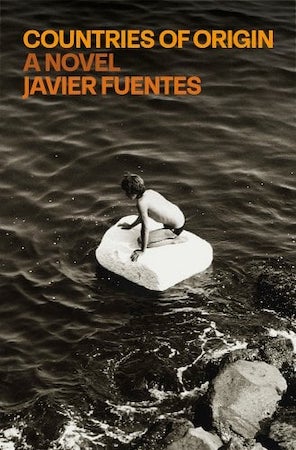
What he does find, and what Fuentes renders so beautifully, is that home is more than place alone—it’s a swath of people. The people who raise us and help guide us through a murky world. People who shape and sustain culture. People who tether us to a ground when stability has been shattered. For Demetrio, it’s in Jacobo—a student he meets on the plane to Spain, whose aristocratic background is a stark difference to the world with which Demetrio was once familiar—finds a tether, a life raft, over a whirlwind of a summer.
Fuentes and I emailed about immigrant narratives, mentorship within marginalized communities, and the particularities of young, queer love.
Christopher Gonzalez: Countries of Origin is rooted firmly in two places, but also a specific year: 2007. What was going on in New York and Spain during 2007 that provided an opening for this novel?
Javier Fuentes: The novel, as you say, is very much about two places, and the constant feeling of foreboding that Demetrio experiences about his undocumented status and his fear of being pushed out of the United States. That sense of impermanence defines the way in which he moves through the world, and the kind of intimacy and interpersonal relationships he is able to engage in.
Impermanence defines the way in which he moves through the world, and the kind of intimacy he is able to engage in.
Regarding the year, I wanted the story to take place after 9/11 and during the Bush administration. That was the time when E-Verify was implemented by the Department of Homeland Security, a system to confirm eligibility of employees to work in the United States. Of course, the first half of 2007 were the leading months to the subprime mortgage crisis, but no one knew yet that we were about to enter the most severe financial crisis since the Great Depression. For believability purposes, I needed to place the story before 2008 because knowing Demetrio as I do, I am not sure he would have pursued a job in the middle of a global economic meltdown.
CG: Demetrio, like many cooks and back-of-house staff in restaurants, especially in New York City, is undocumented. At the start of the novel he’s facing the possibility of deportation, so he opts for voluntary departure and leaves knowing he isn’t able to return to the United States for another decade. Can you talk about writing about this angle of one of the many possible immigrant experiences?
JF: Since moving to New York from Madrid in the late ’90s, I became interested in stories about emigration as I looked for ways to understand my own story. As someone who has gone through the process of cultural assimilation and has built a life in a different country, I spent many years fearing not being able to stay. Up until I got my permanent residency and then my citizenship, I felt that the life I had worked so hard for, could one day be stripped from me. So, putting the protagonist in that position and forcing him out of the country was a way to explore a personal fear that I had suffered from for a long time.
Then years later, in grad school, I studied the American immigrant novel of the 20th century. All the novels I read were about the influx of migrants into the United States and their process of cultural assimilation, but I couldn’t find stories about the reverse journey: People who, after having moved to the United States and assimilated in different degrees, are forced out. That was the main reason why I chose to write an immigrant novel from that vantage point. I felt it was a story others could benefit from reading.
CG: While Demetrio feels adrift in both Madrid and New York City, he’s always anchored by a mentor. There’s his uncle, Chus, who acts as a parent and queer elder; the Chef from his first restaurant job; and, in a way, Jacobo, who becomes Demetrio’s guide when he first arrives in Spain. We always think of mentorship in relation to career moves, but do you see it as a crucial part to navigating not just place but one’s own identities?
JF: Absolutely. Queer people who, like me, felt like outsiders in their own families growing up, had to look elsewhere to understand our sexuality, learn about the possibility of a life outside heteronormativity and build our own identities. Finding mentors and creating families that didn’t resemble the traditional structure is a crucial part of the queer experience. Also, as a foreigner, I benefited immensely from more experienced immigrants who generously shared their knowledge about the cultural challenges and legal hoops that come with establishing in a different country.
I had been terrified of being forced out of a place that had given me so much.
One of the beautiful things about mentorship is that it is not a one-way street. I have come to understand that once you have acquired the right experience or have “grown up”, you are in the position to help others who are in a way, similar versions of who you once were. It is incredibly rewarding because you are given the opportunity to pay back and help, in my case, two communities that are very dear to me, the queer and immigrant communities, which were crucial in my development, both as a writer and a human being.
CG: Demetrio is a pastry chef. What is it about pastry, specifically, that felt right for his character?
JF: I made Demetrio a pastry chef for a variety of reasons. Back in the day, shortly after moving to New York, I worked in the service industry, so it is a world I know well. Also, I have been fascinated with pastries since a friend of mine who is a pastry chef, took me to the Big Sur Bakery in California. The world of pastries felt like a universe I would be happy inhabiting for a long time. And when I started to think about a job where you could become successful and go up the ladder without having the right papers, a pastry chef felt just right.
CG: Were you always a foodie and are there any food writers you turned to while working on the novel?
JF: Having met people in the service industry who are intensely passionate about food, I wouldn’t call myself a foodie, though I get so much pleasure from a good, long meal with friends. In terms of inspiration, apart from watching Julie and Julia by Nora Ephron several times, the only food writer I read while doing research for the novel was M.F.K. Fisher, whose book How to Cook a Wolf I simply adore. W.H. Auden once said of her: “I do not know of anyone in the United States who writes better prose.”
CG: Are the dishes Demetrio prepares (for example, the ice cream with marigold) based on real dishes you’ve had before, or are they your own imagined desserts?
JF: The dishes are imagined. Upon reading the novel, two pastry chefs reached out and asked whether I had trained as a baker or whether the desserts were solely based on research. Both said they sounded very plausible. I am curious to see if they could become real. I have always been interested in the line that separates fiction from reality. Though it is most common to see fiction borrowing elements from reality, it could easily be the other way around. An element, an idea, or a dessert from the world of fiction could cross into the realm of reality. That is why I would be interested in having a pastry chef make these desserts. For those reading this, consider it an open invitation. I mean wouldn’t you be thrilled by a meringue cake, inspired by fashion designer Alexander McQueen, with candied clementines, smaller meringues crumbled on top, edible gold leaf, and candied lemon-peel feathers? I know I would.
CG: I’ve often heard that love finds us when we least expect it, but lately I’ve wondered—and this novel affirms it—that love finds us when it’s least convenient, if not the most challenging times in our life. As in, Demetrio is starting over, needs to find work and a new way of life, and just left behind everything he knows. What does it mean to you for one to be open to love?
I couldn’t find stories about the reverse journey: People who, after having moved to the United States and assimilated, are forced out.
JF: Love, like life, is all about timing. There is a moment in the novel when Demetrio, the protagonist, is at the Museo Reina Sofía in Madrid wondering what would have happened if he had met Jacobo at a club, at a gym, or at a museum. Said a different way, if they had met under different circumstances. To truly be open to love, one needs to have done a lot of self-exploration. When I was in my mid-twenties, I was too busy just trying to make ends meet and figure out how to stay in a country that allowed me to live more freely. In retrospect, I wasn’t ready to love because it was a very challenging and confusing time in my life. Writing a novel about two characters who are in their early to mid-twenties was a way for me to revisit that moment in time.
CG: Something I’m drawn to in my own writing is the blurriness and friction between the platonic and romantic in relationships between queer men, as well as the tensions between eroticism and violence. Demetrio and Jacobo’s relationship has quite the arc in this sense — was this in-between space something you were thinking about when constructing the shape of their relationship?
JF: For queer people growing up in the shadows, platonic love is oftentimes the only version of love we get to experience in a romantic context. Demetrio, who was raised on the Lower East Side of Manhattan by his liberal uncle, is very comfortable with his sexuality. On the other hand, Jacobo, raised in a conservative family with strict traditional values, suffers from extreme internalized homophobia, so much so that at the start, he is unable to process his feelings for Demetrio. The violent episode that takes place in the book is nothing else but his version of intimacy, a version enacted by the heteronormative constraints in which he grew up.
The significant difference in how the characters map to their sexual desires was very purposeful. I wanted to create a correlation between the effects of what a conservative and a liberal upbringing can have in how queer people are able to love themselves, and, by extension, love others.
CG: Earlier, you mentioned fear—what were the questions you had about fear going into the book, and what answers did the book offer you on the other side? And did you ever find those stories you were searching for?
JF: I have always found art instrumental in providing answers to many of the questions life poses. In that sense, and since I was very young, I have been turning to literature to better understand my own story.
When I started writing Countries of Origin, I was not aware of the fact that, by imagining the story of someone being pushed out of the country, I was exploring a fear that I had had for so many years. As I mentioned before, I had been terrified of being forced out of a place that had given me so much. New York is where I came to terms with my sexuality and forged my most meaningful relationships, where my chosen family came to be. For a long time, I feared losing it all. So this fictional world, Demetrio’s return to Madrid, helped me explore the hypothetical, and delve into what it would be like for me to leave the country permanently. Now, upon completing the book and reflecting on the story, one of the main takeaways has been that the possibility of leaving will stay, for now, just that: a possibility.