


The Amgen logo is displayed outside Amgen headquarters on May 17, 2023 in Thousand Oaks, California.
Mario Tama | Getty Images
Amgen is taking a new approach as it tries to stand out in a crowded field of drugmakers racing to develop the next blockbuster weight loss drug.
The biotech company is testing an injectable treatment that helps people lose weight differently from the existing injections from Novo Nordisk and Eli Lilly, and other obesity medicines in development. Amgen’s treatment, called MariTide, also appears to help patients keep weight off after they stop taking it. Â
The drugmaker is also testing its drug to be taken once a month or even less frequently, which could offer more convenience than the weekly medicines on the market.Â
It’s too early to say how competitive Amgen will be in the budding weight loss drug space, which Novo Nordisk and Eli Lilly have so far dominated.
Some analysts expect the market could be worth $100 billion by the end of the decade, potentially leaving room for new competitors to enter. Goldman Sachs also projects that between 10 million and 70 million Americans will be taking weight loss drugs by 2028.
The available data on Amgen’s injectable drug is promising, but it’s from a small, early-stage clinical trial. The Thousand Oaks, California-based company also is developing an oral medicine and other treatments for obesity, but has disclosed few details about them.Â
Investors and health experts will likely get a better idea of Amgen’s prospects later this year: The drugmaker expects to release initial data from an ongoing mid-stage trial on MariTide, along with phase one data on its obesity pill.Â
It’s also unclear whether Amgen’s treatments will be cheaper than the existing weight loss drugs, which cost around $1,000 per month.
Wegovy from Novo Nordisk and Zepbound from Eli Lilly lead a new class of obesity treatments that has drawn unrelenting patient demand — and investor interest — despite their hefty price tags and limited insurance coverage.Â
Eli Lilly and Novo Nordisk have also struggled to offer enough supply of their treatments, which could give other companies a chance to win market share. Â
How Amgen’s treatment is different
Amgen’s drug offers a new twist on weight loss.Â
Much like Wegovy and Zepbound, one part of Amgen’s treatment activates a gut hormone receptor called GLP-1 to help regulate a person’s appetite.Â
But while Zepbound activates a second hormone receptor called GIP, Amgen’s drug blocks it. Wegovy does not target GIP, which suppresses appetite like GLP-1 but may also improve how the body breaks down sugar and fat.
Amgen’s decision to tamp down rather than boost GIP activity is based on genetics research suggesting that blocking the receptor is linked to lower fat mass and body weight, company executives have said.Â
Some approved and experimental weight loss drugs
- Wegovy from Novo Nordisk: Approved weekly injection that activates GLP-1
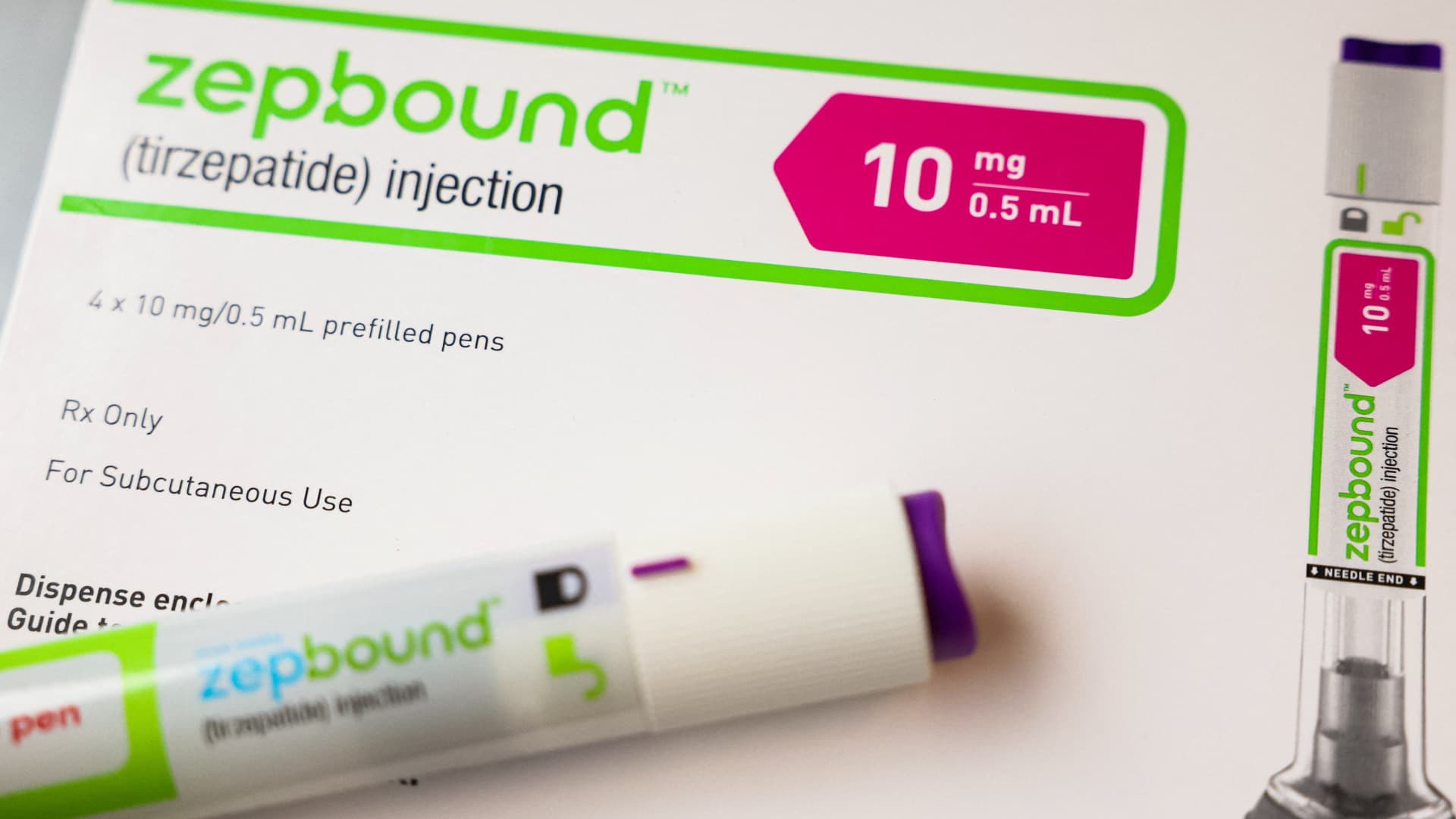
- Zepbound from Eli Lilly: Approved weekly injection that activates GLP-1 and GIP
- Saxenda from Novo Nordisk: Approved weekly injection that activates GLP-1
- MariTide from Amgen: Experimental monthly injection that activates GLP-1 and blocks GIP
- Danuglipron from Pfizer: Experimental once-daily pill that activates GLP-1
- VK2735 from Viking Therapeutics: Experimental weekly injection that activates GLP-1 and GIP
- Pemvidutide from Altimmune: Experimental weekly injection that activates GLP-1 and another gut hormone called glucagon
- GSBR-1290 from Structure Therapeutics: Experimental weekly pill that activates GLP-1
- Survodutide from Zealand Pharma, Boehringer Ingelheim: Experimental weekly injection that activates GLP-1 and glucagon
That appears to contradict how Zepbound works. Eli Lilly’s approach has proven successful: The treatment helped patients with obesity lose up to 22.5% of their weight after 72 weeks in a late-stage trial.
But Amgen’s MartiTide also was effective in a small, early-stage study.Â
Patients given the highest dose of Amgen’s drug — 420 milligrams — every month lost 14.5% of their body weight on average in just 12 weeks, according to data from the phase one trial published last month in the journal Nature Metabolism.Â
There’s a broader debate among researchers about why both approaches – blocking and activating GIP – are effective at promoting weight loss.Â
One theory is that repeatedly activating the GIP receptor, as Zepbound does, ultimately causes the body to “self-regulate” itself and make sure there isn’t too much GIP activity, said Dr. Caroline Apovian, a director of the Center for Weight Management and Wellness at Brigham and Women’s Hospital.
That decreases GIP activity overall, which is thought to essentially mimic what Amgen’s drug achieves when it blocks the GIP receptor. But Apovian cautioned that “none of this is proven” and more data is needed.
The drug could result in longer-lasting weight loss
Amgen’s treatment may be better at helping people maintain weight loss than competitors, even though patients take it less frequently, early-stage trial data suggests.
Amgen’s study enrolled 110 patients with obesity but not diabetes. Patients in one group were randomly assigned to receive a single dose of the drug and were followed for 150 days, while a second group was given a dose every four weeks for three months.Â
An obesity patient takes a injection of weight loss medication.
Joe Buglewicz | The Washington Post | Getty Images
Patients who received a single shot of the highest dose of MariTide lost up to 8.2% of their body weight after 92 days. That suggests a single injection of the drug has a prolonged weight loss effect, according to the study authors.Â
In the group that received multiple doses of the drug, patients appeared to maintain their maximum weight loss until around two months after their last dose. Their body weight started to slowly return after that. Still, their weight was as much as 11.2% lower five months after they received the last dose.Â
“We think meaningful weight loss is already 5%. If you take Amgen’s drug, lose 14.5%, stop the drug and still have 11.2% weight loss after a few months, that’s significant,” said Dr. Holly Lofton, director of the Weight Management Program at NYU Langone Health and an obesity medicine physician. But she pointed out the need to study the treatment in a larger group of people.Â
The sustained weight loss in Amgen’s study appears to contrast with results seen in clinical trials on Zepbound and Wegovy. Patients in those studies saw their weight rebound sooner after stopping the injections.Â
Once a month or even less frequent dosingÂ
The frequency of Amgen’s drug also sets it apart. Those on Wegovy or Zepbound have to take doses weekly, compared with the once-monthly MariTide.Â
Amgen’s trial used monthly dosing in part because patients saw sustained weight loss whether they had a single injection or multiple shots of the company’s drug, according to the study authors.Â
Amgen’s treatment also can stay in the body for much longer than current therapies like Wegovy and Zepbound because it includes a monoclonal antibody, the authors added.Â
An injection pen of Zepbound, Eli Lilly’s weight loss drug, is displayed in New York City, U.S., December 11, 2023.Â
Brendan McDermid | Reuters
Amgen’s MariTide “has that advantage where it’s just going to last a lot longer. Even if you give a high dose, you’re still going to have drug exposure in the body for a month or two months, so that clearly shows you don’t need to take it every week,” William Blair & Company analyst Matt Phipps told CNBC.
Phipps said people typically don’t want to get injections often, so some patients could prefer a monthly shot like Amgen’s MariTide for a disease that will likely require chronic treatment.Â
But he noted that a patient’s choice may also depend on whether the level of weight loss and side effects of Amgen’s drug end up being on par with those of the existing weekly injections.Â
Amgen’s ongoing phase two trial is exploring whether patients can take its drug even less frequently than once a month.Â
Phase two trial will bring more clarity
Amgen’s longer-term phase two study on nearly 600 patients will provide more clarity on how competitive MariTide will be against Wegovy and Zepbound. The company is exploring which dose strength and schedule is best for patients. It expects to release initial trial results later this year.Â
Some analysts have said the phase two trial could help address several questions, including how well patients tolerate the treatment at different dose regimens.
The 52-week study is testing 11 different patient groups at a variety of dosing levels and regimens. That includes starting some patients at a lower dose of a drug and gradually increasing it until they reach a higher target dose.Â
That dose escalation could help reduce side effects that some patients experienced after taking their first dose of MariTide in the phase one trial, according to Phipps.
In that trial, the safety and side effects of Amgen’s drug were similar to other GLP-1 medications. Nausea and vomiting were the most commonly reported side effects, and typically lasted for about 72 hours.Â
Four out of eight patients in a group receiving the highest dose of the treatment withdrew before getting a second shot due to mild gastrointestinal issues, according to the study. But no other patients stopped taking the drug due to adverse events across any of the different dosing groups, Amgen Chief Medical Officer Paul Burton said during a conference earlier this month.Â
“It’s a little early to jump to the conclusion that the drug won’t be tolerated by patients based on this phase one data,” William Blair & Company’s Phipps said.
Another part of Amgen’s phase two trial will also examine weight loss beyond 52 weeks, which will provide a clearer picture of how long the drug is effective.
Read the original article here