


Despite engaging in human sacrifice, the people who lived in the Lambayeque Valley of northern Peru had low levels of violence, a new study of their remains finds.
Human sacrifice occurred in the valley over the millennia. It’s thought that at least some of these mass sacrifices were attempts to appease the gods in the wake of El Niño, a periodic weather phenomenon that can lead to intense rains and flooding in Peru and droughts in other parts of South and Central America.
“We have one example at the site of Sicán where around [A.D.] 1050/1100, around 200 individuals were killed and ritualistically buried during an intense El Niño event,” study co-author Haagen Klaus, an anthropology professor at George Mason University in Virginia, told Live Science in an email.
Latest Videos FromLive Science
Other human sacrifice findings include more than 200 children found near the modern-day town of Huanchaco who were sacrificed sometime between 600 and 800 years ago, possibly during an El Niño.
However, despite the occurrence of human sacrifice, levels of violence unrelated to sacrifice were actually quite low in the Lambayeque Valley. In the study, scientists analyzed the skeletal remains of 1,519 people from the Lambayeque Valley who lived between roughly 1500 B.C. and A.D. 1800, and whose remains were preserved enough to detect signs of violent trauma, including interpersonal violence.

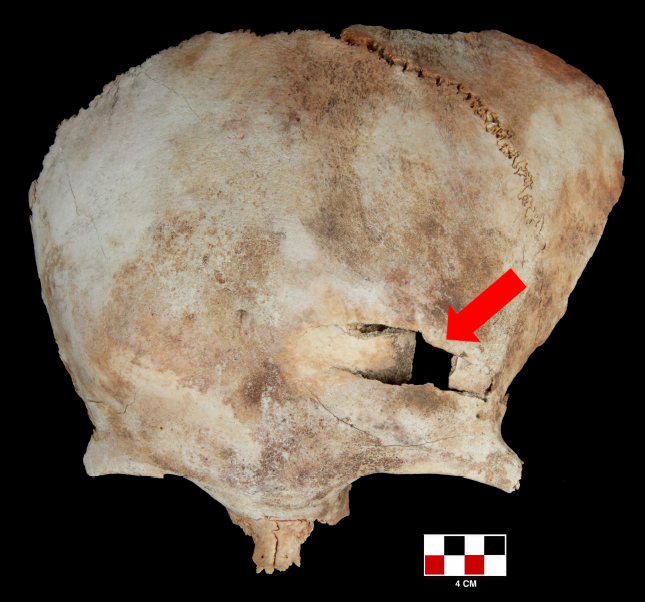
A skull showing blunt force trauma that dates to the Chimu period, roughly 1375 to 1490.
(Image credit: Haagen Klaus)
Of these skeletons, “only 25 (1.6%) exhibited traumatic lesions consistent with interpersonal conflict, and 77 exhibited post-cranial traumatic lesions consistent with accidental trauma (5.1%),” Klaus and co-author Thomas Snyder, a bioarchaeologist at New York University, wrote in the paper, which was published Nov. 8 in the journal Frontiers in Environmental Archaeology.
The team didn’t find any link between a person’s sex and violence, they noted. The findings mean that despite the presence of human sacrifice, the amount of violence unrelated to sacrifice was low. This leaves a question: Why?
Get the world’s most fascinating discoveries delivered straight to your inbox.

A healed fracture on the left leg of a person who lived sometime between 1000 to 650 B.C. The fracture may have been from an accident.
(Image credit: Haagen Klaus)
“Ritual violence may have alleviated non-ritual violence by creating spaces where social tensions could get worked out in a few different ways,” Klaus said.
It’s important to remember that other areas of Peru also practiced human sacrifice but didn’t have the same low levels of interpersonal violence. Klaus noted that areas in the Peruvian highlands sometimes had higher rates of interpersonal violence. In their paper, Klaus and Snyder noted that societies that originated in the highlands, such as the Tiwanaku, Wari and Inca had to grapple with poorer soils and cold temperatures, and these challenges may have been a factor in increasing the levels of interpersonal violence.
The “evidence of sub-lethal and lethal violence forceful enough to break bone is significantly higher in some areas of Peru’s highlands,” Klaus said. He and Snyder noted in their paper that the inhabitants of the Lambayeque Valley may have had better access to marine and water resources, such as seafood and rivers that could be used for agricultural irrigation, than those who lived in highland areas. Access to these resources may have helped alleviate interpersonal violence in the valley by providing more food resources, they wrote.
Scholars react
Aside from practicing human sacrifice, people in the valley may have engaged in other practices that helped lower levels of interpersonal violence, researchers who were not involved in the new study told Live Science.
Environmental conditions may have helped reduce conflict or there could be “really unusual cultural practices in this region of avoiding or mediating conflict — both between and within groups,” Elizabeth Arkush, an anthropology professor at the University of Pittsburgh, said in an email.
Constanza Ceruti, an anthropologist and explorer with the National Geographic Society, said in an email that she’s glad that researchers are studying human sacrifices “after decades of being ignored as a taboo topic in academic discussion.” She praised the study’s large sample size and noted that human sacrifice is a “phenomenon primarily associated [with] the manipulation and concentration of power by elites.”
Jordi Rivera Prince, an anthropology professor at Tulane University, said that the findings dovetail with her excavations in the region, where she has “found little evidence of violent trauma during the Salinar (400-200 BCE), a period of great social change in the Andes.”
Weston McCool, an archaeology professor at Cal Poly, said in an email that the newly published paper “is an interesting study that provides additional evidence for a sharp break in patterns of violence between the Andean coast and highlands.” He noted that it “supports the hypothesis that coastal populations were buffered from terrestrial environmental downturns in ways that highland populations were not. The nature of that resilience, however, remains an important question for future research.”
Snyder, T. J., & Klaus, H. D. (2026). Pax Lambayeque? Trauma, interpersonal violence, and environment over 3,000 years in the Lambayeque Valley Complex, Peru. Frontiers in Environmental Archaeology, 5, 1889466. https://doi.org/10.3389/fearc.2026.1889466
Read the original article here