


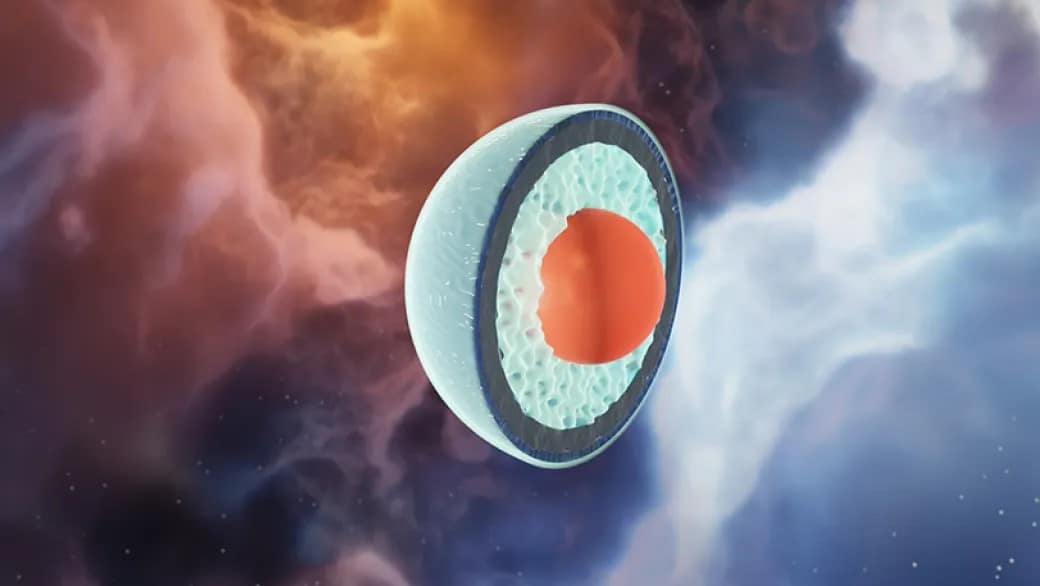
It is very likely that ultra-dense deconfined quark matter exists in the cores of the most massive neutron stars, according to a study by an international team of physicists. The team led by Aleksi Vuorinen at the University of Helsinki applied Bayesian inference to observations of neutron stars and concluded that there is a 80–90% that the exotic state of matter exists in the heaviest objects.
At extreme temperatures and pressures, quantum field theory predicts that quarks and gluons no longer bind tightly to each other – as they do in protons, neutrons and other hadrons. Instead, they are free to exist individually in an exotic quark–gluon plasma called deconfined quark matter.
It is believed that this state of matter dominated the universe in the very first moments following the Big Bang. It has also been created very briefly at facilities like the Large Hadron Collider by smashing heavy nuclei together.
Dense and compact objects
“While the experimental study of high-density nuclear and quark matter with particle colliders remains extremely challenging, it has long been known that quark matter may be present in nature in the cores of neutron stars – the densest and most compact astrophysical objects in existence,†Vuorinen explains.
Neutron stars are the collapsed cores of stars that pack more than a Sun’s worth of matter into objects just 10–20 km in radius. The density of a neutron star is expected to increase from its crust to its core. As a result electrons and protons in the interior of such a star are expected to be crushed together to create matter that is mostly neutrons.
What is more, some physicists believe that the temperature and pressure at the core of a neutron star could be high enough to allow a phase transition from hadronic matter to deconfined quark matter. To search for evidence of such a phase transition, Vuorinen’s team used “Bayesian inferenceâ€, which is a method for statistical deduction infers the likelihoods of different model parameters by making direct comparisons with observational data.
Equation of state
In this case, the observations are the “equations of state†of neutron stars. The equation of state relates the pressure in a neutron star to the density – and can be inferred by observing properties of a neutron star such as its mass and radius.
“We combined this approach to a framework we had earlier pioneered in the study of neutron-star matter, where the equation of state of dense quark matter is interpolated between accurately known low- and high-density regimes,†Vuorinen explains. Since the equation of state of deconfined quark matter is expected to be fundamentally different to that of hadronic matter, this approach should identify the presence of deconfined quark matter in the cores of observed neutron stars.
For their study, Vuorinen and colleagues used equation of state calculations from 12 neutron star observations.
“Similar studies have been performed before, but we were able to both take an unprecedented number of observational results into account in our study, and to deduce the phase of strongly interacting matter from the results,†Vuorinen describes. Using their recently-developed framework, the team used a supercomputer to calculate the likelihood that deconfined quark matter is present in the cores of the heaviest neutron stars they examined.
Strong first-order phase transition
“The results were in the ballpark of 80-90%, which is high, but by no means constitutes a discovery,†Vuorinen continues. “The remaining 10-20% likelihood corresponds to a very interesting scenario in itself: we were able to show that should all neutron stars in existence be composed of nuclear matter alone, there needs to be a strong first-order phase transition separating the nuclear and quark matter phases.â€

Neutron stars may contain free quarks
From an astrophysical perspective, the possibility of deconfined quark matter existing in neutron star cores raises a whole host of intriguing new questions, explains team member Joonas Nättilä at the Flatiron Institute and Columbia University in New York City.
“Now that we know there can be such a new state of material lurking inside neutron stars, we can start to speculate how it affects various astrophysical phenomenaâ€.
He says the research raises some very interesting questions. “Can we temporarily release the quark matter in a collision of two neutron stars? Can we, at some point, hope to observe the collapse of a neutron star into a black hole if the matter undergoes a strong phase transition? Does the quark-neutron matter interface change the internal structure of the star?â€
In their future research, the team will aim to delve deeper into these fascinating questions.
The study is described in Nature Communications.