


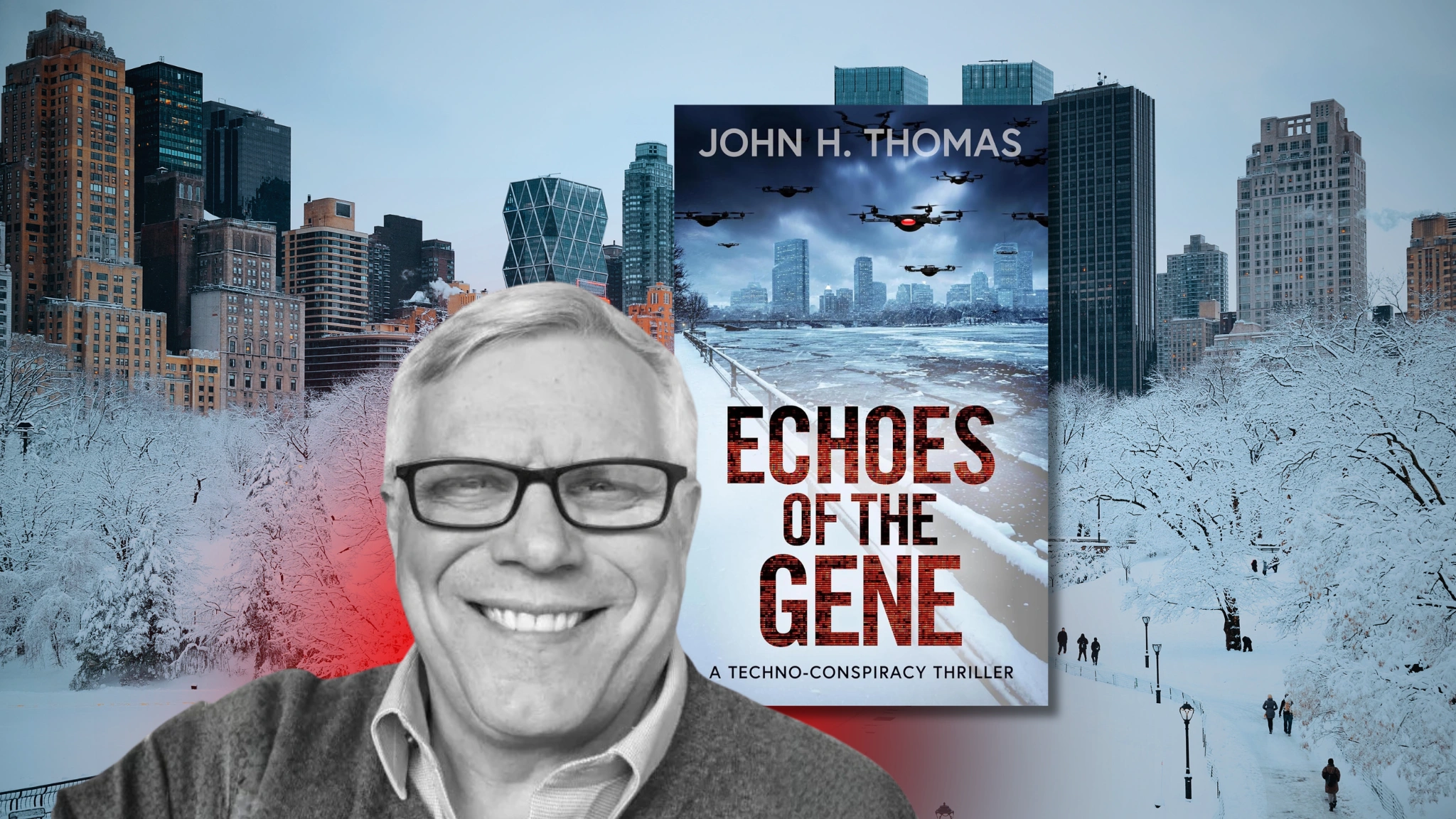
In Echoes of the Gene, John H. Thomas blends high-stakes science fiction with deeply human questions about empathy, grief, fate and free will. At the heart of the novel is Emily Harper, a young woman whose extraordinary ability to experience the emotions of others forces her to navigate a world shaped by powerful technologies, hidden agendas and devastating personal loss. In this interview, Thomas discusses the inspiration behind Emily’s unique gift, the ethical dilemmas raised by predictive intelligence and genetic discovery and why the most compelling stories about technology are ultimately stories about people.
Emily Harper experiences other people’s emotions as if they’re her own. What inspired this concept, and what did it allow you to explore that a more conventional protagonist couldn’t?
I came to it through a question that has always interested me: how much of who we are is fixed at birth and built by what we live through? The series was always meant to examine human experience across a lifespan. Not just the events themselves, but also how we process them through emotion and intellect and where nature ends and nurture begins. Emily’s gene allowed me to turn that question into a physical expression.
Recent research on empathy helped crystallise the idea for me. Empathy is only valuable when it fits the situation. It becomes dangerous when it overwhelms judgement, biases us towards whoever is most visible, exhausts the person feeling it, or gives a manipulator a map of someone’s vulnerabilities. That is exactly Emily’s dilemma in Echoes of the Gene. Her empathy is not automatically noble. It is perception, connection, and care, but it is also a burden, a weapon, and a weakness, often all at once. A conventional protagonist can choose how much to feel. Emily cannot, and that lack of a filter forced me to write a character who is constantly negotiating the line between understanding others and being consumed by their emotions.
The novel combines cutting-edge technology with themes of grief and sacrifice. How did you balance the science-thriller elements with the emotional core of the story?
I spent a career watching how institutions, technology, and people behave under pressure, and the lesson that stayed with me is that the technology is never really the story. The story is what technology does to people.
I tried to let the science set the stakes and the grief carry the weight. The terminal gene, the predictive intelligence, and the institutional machinery around them are more real than speculative. They exist to put pressure on Emily’s most human attachments. A thriller works best when the reader is racing through it for the plot and then realizes, somewhere near the end, that they were reading about loss the whole time. If a scene only advanced the technology, it had to go. If it advanced the technology and cost Emily something, it stayed.
A major tension in the book comes from Emily being hunted by an intelligence that understands her patterns and decision-making. What questions about human agency and technology were you hoping readers would consider
The question I kept circling was whether a system that can predict what you will do has, in some quiet way, already taken the choice away from you. We are surrounded now by technologies built to anticipate our choices, and most of them are framed as conveniences. I wanted to push that to its unsettling conclusion: what happens when something models you well enough to shape the conditions you decide within so that you believe you are choosing freely while you are actually being steered?
That is the heart of the fate-versus-free-will thread that runs through everything Emily faces. I am not interested in handing the reader an answer. I would rather they finish the book a little more alert to how often the choices we are most proud of were arranged for us and a little more protective of the ones that are genuinely our own.
The story takes place just days after Tyler’s death has shattered Emily’s world. How did grief shape both her character arc and the decisions she makes under pressure?
Grief is the engine of the entire story, and I wanted it to behave the way genuine grief does rather than the way fiction often tidies it up. Emily never gets to set her loss aside to focus on the crisis. She carries it into every decision. It makes her both more reckless and more clear-eyed, because a person with less left to lose acts differently.
Her empathy compounds this, since she cannot insulate herself from the emotional weight of the people around her while she is already overloaded by her own. What interested me was watching her learn, under enormous pressure, the difference between honoring someone and being ruled by their absence. The arc is not about getting over Tyler. It is about whether she can hold what happened to him and still choose her own path, which turns out to be one of the hardest things she does in the book.
The discovery of the “terminal gene” raises questions about death and what humanity might do with knowledge that could fundamentally change our understanding of it. What drew you to that idea?
I am drawn to that moment in any breakthrough when discovery outruns our wisdom about how to use it, because I have seen smaller versions of it throughout my life. We are very good at finding things and much, much slower at deciding what they should mean. A gene that fixes the moment of death turns that gap into something both personal and absolute. Suddenly, the most private fact about a person becomes data, and data gets owned, traded, and weaponized.
What compelled me was less the science-fiction aspect than the entirely believable human response: the way institutions would race to control such a thing long before anyone asked whether they should. The book opens with two epigraphs that frame this exactly, one from Alan Valentine about the devil seizing every discovery while the angels debate how to use it, and one from Isaac Asimov about science gathering knowledge faster than society gathers wisdom. That gap is the world the entire series lives in.
Trust seems to be a recurring theme throughout the novel, as Emily must rely on allies while never being certain who may betray her. Why was that theme important to this story?
Because trust is where Emily’s gift becomes most treacherous, she can read what a person is feeling, but feeling is not the same as intention, and a skilled manipulator can offer her genuine warmth while working against her. I wanted her perception to be an advantage, but also not enough.
That tension felt true to how betrayal actually works. The people who can hurt us most are rarely strangers. They are the ones we already rely on. Surrounding Emily with allies whose loyalties stay genuinely uncertain let me keep her, and the reader, in that uncomfortable and very human position of having to act on incomplete trust anyway. Survival in her world is not about finding someone perfectly trustworthy. It is about deciding who to believe, knowing you might be wrong, and accepting the consequences of that choice.
What do you hope readers take away from Echoes of the Gene after they turn the final page?
I hope they close the book feeling they have read a propulsive thriller and also sat with unsettling questions that linger. The questions Emily faces about fate, choice, and what we owe the people we love are not science fiction. If a reader finishes the story more curious about where the line falls between what is determined for us and what we build ourselves, then the book has done its work.
I will also say that Emily’s story is not complete. She ends this book changed but not finished, with a clearer sense of what has been taken from her and what she still refuses to concede. The next part of her story begins there, not with escape, but with choosing.
Read the original article here