


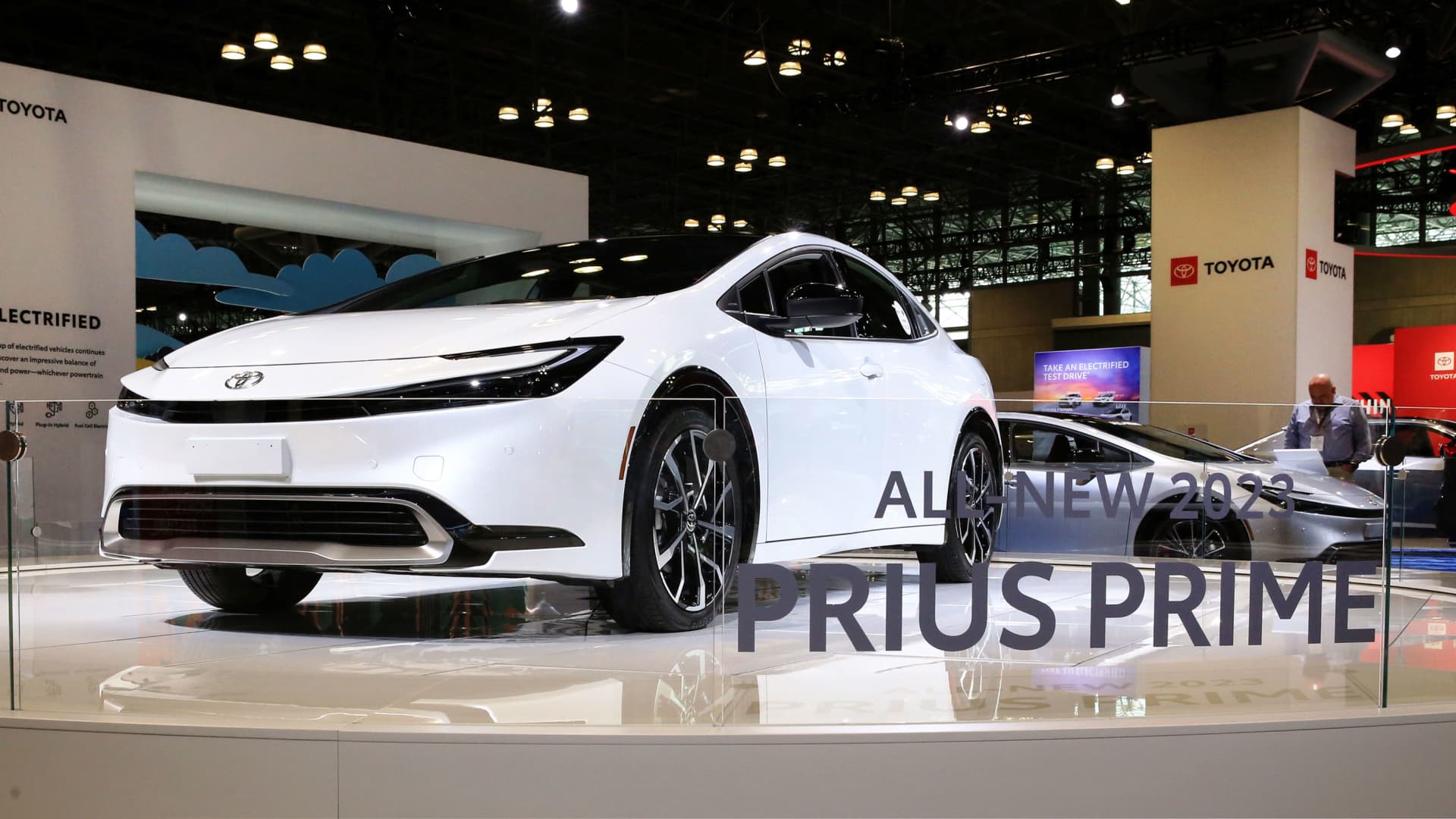
2023 Prius Prime on display, April 6, 2023.
Scott Mlyn | CNBC
PLANO, Texas — Twenty-five years after introducing many Americans to hybrid vehicles with the Prius, Toyota Motor is targeting significant growth in plug-in hybrid electric vehicles, or PHEVs.
Such cars can function as an all-electric vehicle for a certain number of miles before they need a traditional gas-powered engine. Unlike traditional hybrids like the Prius that use a small amount of battery technologies, PHEVs also need to be charged with a plug, like an EV, to use the electric range.
PHEVs aren’t new. Toyota first introduced the Prius as a PHEV in the U.S. in 2016, but such plug-ins are experiencing a renaissance as automakers try to meet federal fuel economy standards and emissions regulations. They’ve also acted as potential steppingstones to all-electric vehicles for consumers who might be hesitant to go fully electric.
“We are going to grow our PHEV volume through the lineup over the next few years,” David Christ, head of the Toyota brand in North America, told CNBC during a visit to the company’s North American headquarters. “We love the PHEV powertrain. We’re working to increase, perpetually increase, the amount of miles you can drive on EV-only range.”
Company sources said Toyota plans to increase PHEVs from 2.4% of its U.S. sales volume last year to roughly 20% by 2030. However, they said that could change based on regulations, customer acceptance of electrified technologies and affordability, among other factors.
That percentage of sales would match the amount of PHEV mix allowed under the California Air Resources Board’s Advanced Clean Cars II rule, which requires automakers to exclusively sell zero-emissions vehicles in the state by 2035. President Donald Trump is expected to eliminate that rule.
Toyota’s planned PHEV expansion comes amid the regulatory uncertainty and slower-than-expected adoption of all-electric vehicles, which the company also continues to invest billions of dollars in annually. The performance of PHEVs also continues to improve.
“We’re looking at plug-ins across the lineup, and it’s more a function of where can we build them, and what is the product strength versus the competition,” Christ said.
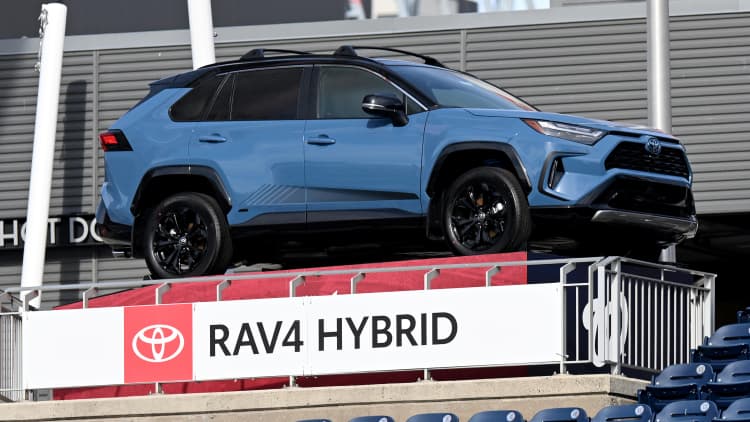
The EV-only range of PHEVs has increased from a few dozen miles in ideal conditions to 50 miles for vehicles such as the automaker’s redesigned RAV4 that was introduced last week.
Sales estimates and forecasts for PHEVs vary, as their sales are limited and not all companies break out such models when reporting results. Several automotive data and forecasting companies expect modest PHEV growth, to between 4% and 5% of U.S. industry sales by 2030.
“The growth is likely limited due to the expensive dual powertrain cost structure. For those already invested, it may make sense to continue along the path,” said Chris Hopson, principal analyst at S&P Global Mobility. “However, for those who haven’t already made significant investments, it is a large incremental cost that must be balanced.”
S&P has PHEV sales in the U.S. growing from about 2% last year to 5% by the end of the decade. AutoPacific expects PHEVs to grow to about 4.2% by 2030, while AutoForecast Solutions expects such sales to be relatively stable around 3.3% over the coming years.
PHEV sales for Toyota, including its luxury Lexus brand, increased roughly 39% last year, according to company data. That included a 30% rise for the Toyota brand’s Prius and RAV4 PHEVs, as well as an 88.6% jump for Lexus’ three PHEVs, including a new “TX” model.
That compares with the automaker’s more than 20 hybrid models that experienced a combined sales increase of 53% last year, including a 56% jump for the Toyota brand amid several new introductions.
“We’re looking across the lineup and saying, ‘How many power trains can we offer on what products?'” Christ said. “We are going to increase the percentage of hybrids and PHEVs.”
Christ said the Toyota brand expects hybrids, including PHEVs, to account for more than 50% of U.S. sales this year, increasing from roughly 46% in 2024 and nearly 30% in 2023.
Cooper Ericksen, Toyota North America senior vice president of product and battery electric vehicles, or BEVs, compared the automaker’s “electrified” vehicle approach to having the bases loaded in a baseball game with different players.
“We’ve got ICE. We’ve got hybrid. We got plug-in hybrid. We got EV,” he said. “So, our chances of being successful in scoring runs is just a lot better than if you’re really overly committed to any one of those powertrains.”
Ericksen, citing Toyota research and studies, said once people understand how PHEVs work and their benefits, there’s a massive swing in customer interest from traditional vehicles, hybrids and even some EVs.
“Once we educate people, by far the biggest swing from all the powertrains is PHEV. It goes up exponentially,” he told CNBC during a separate interview. “PHEV is really important for us. There are people that will consider a PHEV that will not consider a BEV.”
Consumer understanding of PHEVs has been a challenge in the past. It was partially to blame for the slow sales and discontinuation of General Motors‘ Chevrolet Volt, which the automaker produced from 2010 to early 2019.
Many consumers also have voiced concern about having to plug the vehicle in. (But the vehicles can still operate as a traditional gas-powered vehicle without ever being plugged in, which has drawn criticism from some EV supporters.)
PHEVs are also costly due to the need for both EV technologies and an engine. Toyota’s PHEVs currently cost thousands of dollars more than traditional or hybrid vehicles.
“There are a lot of negatives in the production side of it, and buyers, unless they’re forced to, don’t really opt for the PHEV models,” said Sam Fiorani, AutoForecast Solutions vice president of global vehicle forecasting.
Toyota’s 2025 RAV4 PHEV carries a roughly $15,000 price premium over the base model and $12,000 over the hybrid version.
“It’s kind of like getting two cars in one,” Ericksen said. “And if it serves a compliance benefit, maybe we sweeten the pot a little bit on the price to get more people to consider it.”
Read the original article here