



Physics isn’t a popularity contest, but the 10 most read articles published on the Physics World website in 2023 nevertheless make an interesting collection of highlights, lowlights and every kind of light in between. If you didn’t spot these stories when they first appeared, here’s your chance to find out what the fuss was about.
We said in 2022 that the best was yet to come for the James Webb Space Telescope (JWST), and we weren’t wrong. In 2023, NASA/ESA’s shiny new infrared eye in the heavens spotted an ionized molecule that could be involved in the emergence of life; found pairs of rogue planets wandering through the Orion nebula; and refined our knowledge of redshifts in distant galaxies. Heck, it may even have seen “dark stars†– hypothetical objects powered by the annihilation of dark matter rather than boring old fusion reactions. But the JWST story that got the most attention from Physics World readers was science writer Rob Lea’s account of how early galaxies reionized the early universe. This reionization was one of the most important events in the history of astronomy, because it allowed light that would otherwise have been absorbed by hydrogen to travel stupendous distances through time and space to all manner of objects – including the telescope that discovered it. We think this is pretty exciting, which is why it’s also in our list of the year’s top 10 breakthroughs.
One of the great things about physics is that results from hundreds of years ago are often as valid – and as useful – today as they were when physicists first came up with them. Take Christiaan Huygens, whose biggest discoveries came in the two most popular fields of 17th-century physics: optics and mechanics. Three and a half centuries later, Xiao-Feng Qian and Misagh Izadi of the Stevens Institute of Technology found an unexpected connection between these areas of Huygens’ work. By analysing two optical coherence properties, Qian and Izadi showed that they are quantitatively related to centre of mass and moment of inertia through the Huygens-Steiner theorem for rigid body rotation. Neat, eh?
This year was almost certainly the hottest since records began, and the outcome of December’s COP28 summit on climate change won’t change the planet’s alarming trajectory any time soon. Still, Physics World readers took heart from two positive green technology developments in 2023: a lithium battery in China with the highest energy density on record, and a concentrated solar reactor in Switzerland that produces “green†hydrogen at a rate of more than 2 kilowatts and efficiencies above 20%. Both innovations are ably described in this pair of stories by Physics World corresponding editor Isabelle Dumé.
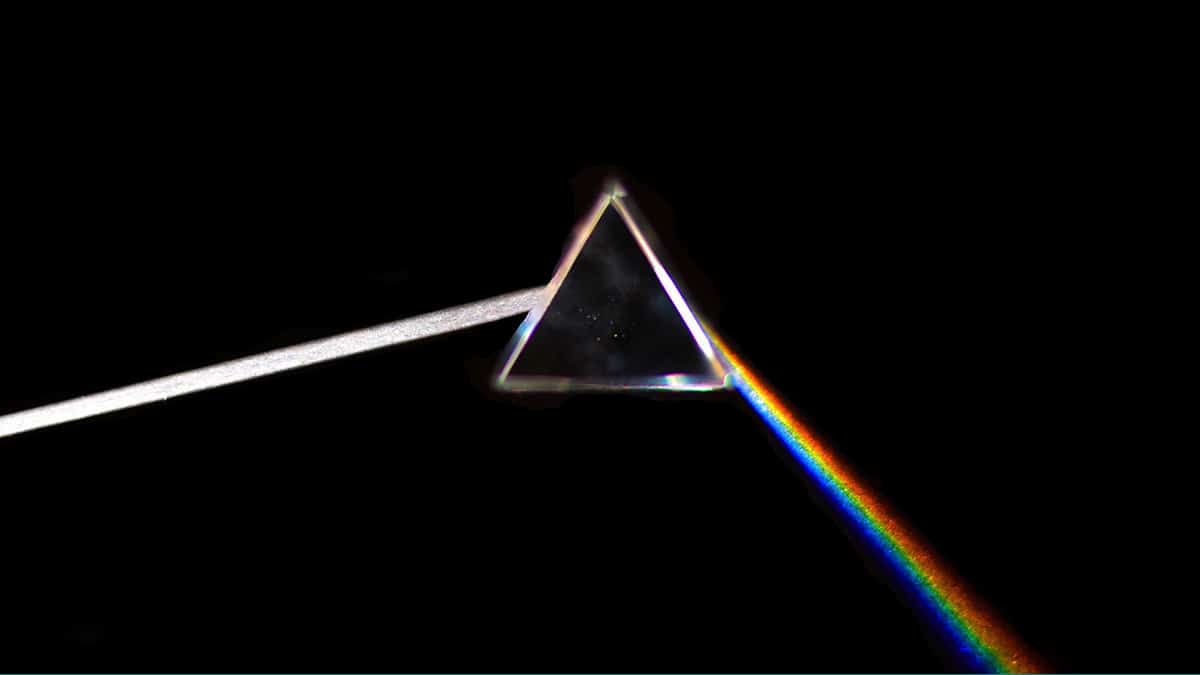
The prism-and-rainbow cover of Pink Floyd’s 1973 album Dark Side of the Moon is an iconic piece of art, but as a piece of physics, the band might as well have set the controls for the heart of the Sun. In this light-hearted essay written to mark the album’s 50th anniversary, physics teacher Tom Tierney describes how he challenged his students to measure the prism’s angle of refraction and find a real material that corresponds to it. The closest possibility, it seems, is the mineral zincite, but ultimately this cover design sent scientific accuracy off to a great gig in the sky.
As the physics Nobel laureate Niels Bohr was (allegedly) fond of saying, it’s hard to make predictions, especially about the future. But that hasn’t stopped the Physics World editorial team from trying to predict the winners of each year’s Nobel Prize for Physics, and in 2023 we got our predictions partly right, correctly including Anne L’Huillier and Ferenc Krausz (though not their co-laureate Pierre Agostini) in our list of possible physics-prize winners. Predicting the 2023 Nobel Prize for Chemistry, meanwhile, was easier than usual thanks to an unprecedented leak of the winners’ names several hours before the official announcement. We’re guessing that winners Moungi Bawendi, Louis Brus and Alexei Ekimov aren’t complaining.
The usual trajectory of a hot technology start-up resembles that of a rock-n-roll star: they live fast, they die young, and depending on how well they’re managed, they either go out in a blaze of IPO glory or get crushed under a pile of federal criminal charges. For some businesses, though, failure takes much longer, and William D Cohan’s book Power Failure: the Rise and Fall of General Electric (reviewed here by Anita Chandran) offers an in-depth analysis of how it happened at one of the 20th century’s biggest technology firms.
For a fortnight at the end of July and the beginning of August, the scientific world – or at least the part of it that spends too much time on social media – went gaga over claims that researchers in Korea had synthesized the first room-temperature superconductor. A material that conducts electricity without resistance under everyday conditions (as opposed to liquid nitrogen temperatures or millions of atmospheres of pressure) would be a major technological breakthrough, so it’s easy to see why the announcement attracted attention. Alas, a flurry of attempts to replicate the supposedly superconducting behaviour of the material called LK-99 came to nothing, and materials scientists had to find something else to do with the rest of their summer holidays.
Which brings us to the most popular article published on the Physics World site this year:

It isn’t every year that a physics-related film becomes a summer blockbuster, so it’s not surprising that our review of Christopher Nolan’s biopic Oppenheimer got plenty of attention from Physics World readers. The jury is out on whether a movie about the deep moral ambiguities of atomic weapons could ever be considered “good advertising†for physics as a discipline, but it certainly got people flocking to the cinema. The film was a massive box-office hit, thanks in part to the “Barbenheimer†phenomenon that saw it paired with the summer’s other big cinematic success story, Barbie, in a surreal double billing. Though the Physics World editorial team’s review of Oppenheimer lacked the star power of Cillian Murphy, Margot Robbie and Ryan Gosling, it nevertheless took the crown as the most-read article published on the Physics World website in 2023.