


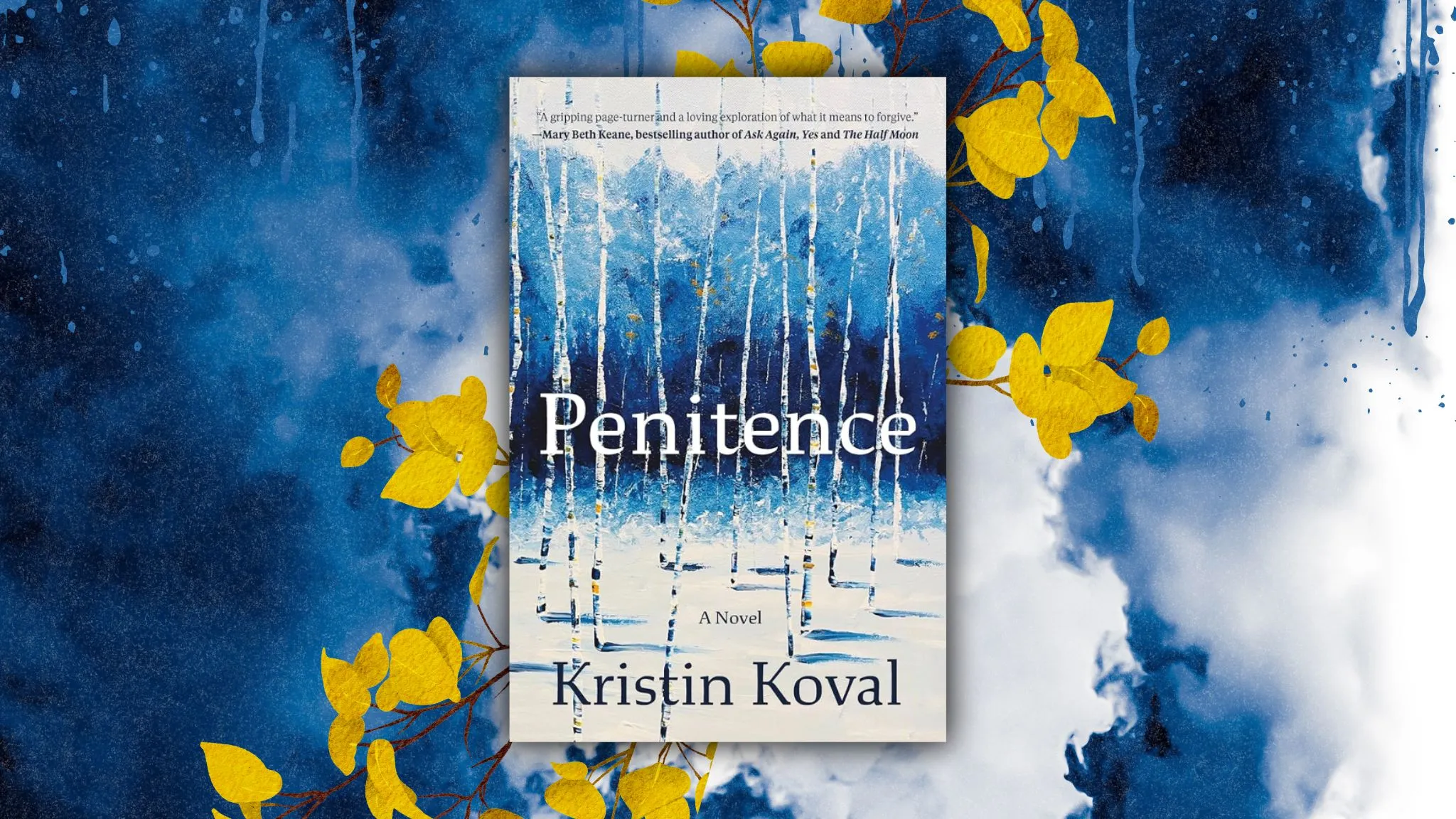
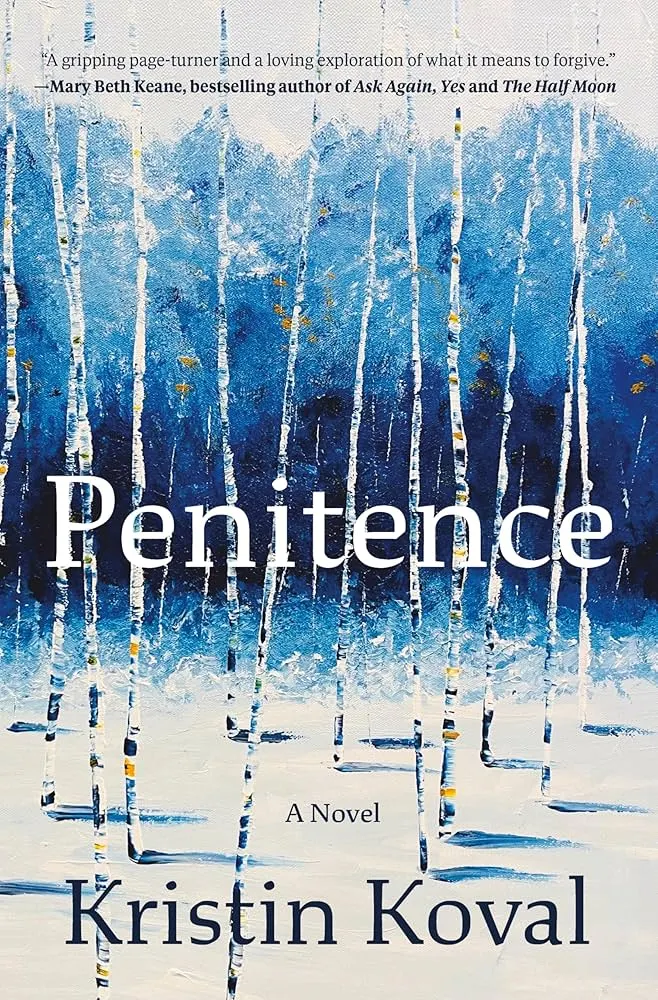
Penitence by Kristin Koval
“Nora Sheehan sits in a jail cell in Lodgepole, Colorado, surrounded by three cinderblock walls and the kind of steel bars she’s only seen on television, gray and cold. She’s thirteen, the woman she might become still a shadow even though she’s ready to discard her childhood. A longing for her stuffed penguin – a gift on her fourth birthday from her older brother Nico – grips her with an intensity she doesn’t understand, and she twists her thin arms around her shoulders, a featherless bird warming herself with naked wings. She doesn’t look like the sort of girl who just shot her brother.”
In the first few pages of Kristin Koval’s Penitence, we meet many of its main characters: Nora, shivering in her cell; her mother, Angie, in shock, alone in her house; her husband, David, pounding on a controversial lawyer’s door in the pre-dawn hours; the lawyer, Martine, alone in bed, her husband dead, jolted awake; Martine’s son, Julian, a criminal defense lawyer in New York City, estranged from his mother and staring dumbfounded at the news on his phone; and Nico, the 14-year-old victim. Nico is in the morgue.
They are all interconnected, in ways they know and in ways they can not even imagine. Julian and Angie were inseparable in high school until Martine and Angie’s mother, Livia, broke them up after an unspeakable tragedy: the skiing death of Angie’s seven-year-old sister, Diana, while the two teenagers were supposed to be watching her. Angie is convinced Diana ran into a tree. Julian knows it’s worse than that. The reverberations carry on to the present, 25 years later: Julian’s drinking and work obsession; Angie’s failing marriage to David; Martine’s deep regrets about past actions; the mysteries of Nico and Nora.
What did happen on that day on the ski slope? Why did Nora shoot her brother once in the eye, twice in the chest, with David’s gun, then call 911 and turn herself in? What secret was Nico harboring that, in death, would turn their worlds upside down once again?
At one point, Julian marvels about “how quick that one moment in his life had happened, how each choice had led to the next, how they’d all gathered together, the weight accumulating and gathering force.” But as he flies back to Colorado to attempt the seemingly impossible job of defending Nora, he has no idea: The landslide isn’t over yet.
Spanning decades, Penitence is a novel about guilt and forgiveness, love and tragedy, about the cost of buried secrets and the fight for redemption. It’ll break your heart; it’ll lift you up. It’ll make you think deeply about the question: Does the worst thing we ever did define us?
Says the author, “I was inspired to write this story by my own powerful experiences with forgiveness, both being forgiven and forgiving other people. Over the course of several years, I’d seen numerous news reports of fratricide (and the concept is as old as time — Cain and Abel, Romulus and Remus, royal siblings in monarchies), and while it’s not common, there are more instances of it than people realize. Every time I read about it, my heart broke for the parents. I realized using fratricide as a starting point for a novel would give me the ability to write about forgiveness in a way that conveyed both its complexities and its rewards, because it placed the parents in both the hardest — and the easiest — possible position to forgive.
“We’ve all made mistakes, and although forgiveness is complicated, hard, and in the end, intensely personal, I hope readers of Penitence are inspired to give it a second chance in their own lives.”
Considerable research was needed, though: “Search engines are helpful, but after some basic research online, I reached out to actual people — legal and medical experts who were friends of friends of friends (sometimes I had to go deep to find those experts!). They directed me to textbooks, white papers, and other resources, and patiently answered my questions. I watched documentaries and read as many books as I could on the criminal justice system (Bryan Stevenson’s Just Mercy was a favorite) and eventually observed a criminal trial of an 11-year-old accused of assault and battery after hitting his teacher with a cloth lunch box.
“The most surprising thing I learned was how poorly the criminal justice system treats young people. Yes, the young people within that system are troubled, but the way we treat them only makes them more troubled, not less. Many states still have laws which require children who have committed certain crimes to be charged as adults, thereby subjecting them to inappropriate adult consequences. Scientific evidence has proven that our brains are not fully formed until we’re 25 years old, and yet we treat not just older teens but younger teens — 13, 14, 15 — as though the decisions they’ve made are fully indicative of the person they someday might become. And, by only applying the concepts of retribution, deterrence, and incapacitation, and effectively ignoring the possibility of rehabilitation and education, the criminal justice system is essentially throwing these children away. They’re rarely given a second chance to be a better person and make something of their lives and they’re certainly not given the tools to do so.
“Of course, this problem is magnified for some because of biases against children and young people who are black or brown, queer, or simply poor. While my original intent was to write about forgiveness on an individual level, I realized I couldn’t tell this story without also focusing on the lack of forgiveness within America’s criminal justice system.”
The story is a complicated one – many lives tightly intertwined, with key facts and revelations doled out strategically. It’s a tricky balance to pull off:
“I didn’t get it right the first time, but that was partly because I deliberately chose to ‘speed write’ the novel and get the story down on paper, and refine the details afterwards. When it was time to refine details, one of my strategies was to make a list of important facts and revelations, then read the entire manuscript and mark where each one occurred. I used a lot of colored highlighters and Post-its in that process! I noted how often a fact appeared and when, and then considered whether something was mentioned too frequently or too soon, because I didn’t want to overemphasize something for a reader and deprive them of the chance to decipher the puzzle on their own. And of course, I had the keen eye of my agent, Gail Hochman, and my editor, Deb Futter, to help.
“When I’m writing something, my mind is on the story all the time, and most of the time it’s on the details, not the bigger picture. When I think of something, I need to write it down immediately so I don’t forget it, and I have details written on Post-its, scraps of paper, emails to myself, and notes on my phone. (I also have a saint of a husband who stops and waits in the middle of a hike or a run while I make a note on my phone and who never complains when I turn the nightstand light back on immediately after going to bed to write on a Post-it.) I probably do more “writing” when I’m away from my laptop and my mind is wandering than when I’m at my laptop!”
Other writers helped, too, in a variety of ways:
“Different books influence me at different times, and often when I can’t figure out how to do something, I pick up a novel to read and end up learning the exact craft lesson I need to learn. For example, from Mary Beth Keane, I learned how to take my characters through blocks of time; from Barbara Kingsolver, I learned how to slow down the narrative in a way that excites the reader rather than boring them; from Lynn Steger Strong, I learned to pay attention to the middle of the novel. I also learn rhythm and creativity from songwriters and pacing from screenwriters when I’m watching television and movies.
“For much of my life, I’ve loved Latin American magical realism — authors like Gabriel Garcia Marquez and Isabel Allende — but when I sit down to write, lyricism is not what ends up on the page! In fact, I’ve been told more than once that people appreciate my economy of words. I often speak plainly, and I love to use words in a precise and unusual way. The thesaurus is my best friend when I write, and I often search long and hard to make sure I’m saying what I want to say on the page. I was that geek of a child who read the dictionary for fun!”
Koval is herself a former lawyer, “who always wanted to be a writer, but initially wandered down other paths.” Here’s her story:
“I started my legal career as a corporate lawyer in a big New York City law firm — though that was a terrible match for me, and it felt like I was dying a slow death at work every day — but then retrained myself as a trusts and estates lawyer. Trusts and estates was a better match because I spent my time with actual people instead of corporations, listening to their stories about their families and lives, then figuring out how to accomplish their post-death goals in their estate planning documents. However, while I enjoyed the work and my clients and colleagues, I’d spent my entire childhood buried in books or writing in journals, and as a lawyer I had no extra energy for creativity and the only time I got to read was on vacation. I knew I was letting something I’d always loved slip away, and started taking evening writing classes. It didn’t take long — in fact, it hit me when I was writing my very first short story — to realize I was passionate about writing in a way I was not about the law.
“Walking away from an actual salary, my identity as a lawyer, and the people I felt committed to — both my clients and my colleagues, who I still miss — was hard, but not scary. What was scary was the possibility of waking up when I was eighty and saying to myself ‘I wish I would have tried.’ I didn’t want to live with that regret.”
Still, there were some bumps in the road before that passion paid off:
“Like most writers, I have a first novel sitting in an archived file on my laptop. I queried about fifty agents for that novel with some positive reactions but no takers before deciding it was time to move on to writing Penitence. And prior to that first novel, I had three different attempts that never resulted in a completed novel. (My most naive attempt was when I thought I’d have enough free time to write a novel while on maternity leave with my first child — but of course as a new mother I couldn’t even figure out how to make time for showers!)
“I wrote Penitence while taking a novel generator class with Lynn Steger Strong through Catapult (they’ve since discontinued their writing workshops). My first round of querying agents didn’t pan out, but when I sent my manuscript to Gail Hochman, she responded overnight with a long email, enthusiastic in her praise and with comments and suggestions that immediately made sense to me. We worked on revisions for about two months before sending it out to publishers on the Thursday night before a long weekend. Deb Futter bought it in a pre-empt overnight, which blew my mind. Gail had warned me it might be weeks before we heard back from anyone, especially since it was a holiday weekend, and the next morning when I saw that I had an email from Gail about the submissions, I assumed it was an immediate rejection and almost didn’t open the email because I wanted to avoid the bad news … but it was Deb’s offer!”
Koval is now at work on another novel, “still in the research phase, but since some of that research involves spending time on friends’ ranches, it’s fun!”
In the meantime, you’ll want to read this gem of a book. Unlike its characters, you’ll have no regrets.
About Kristin Koval:
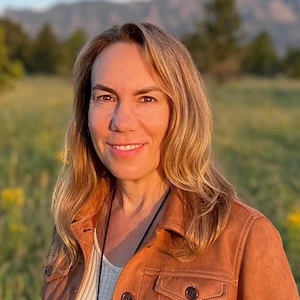 Kristin Koval is a former lawyer who always wanted to be a writer but initially wandered down other paths. She attended Phillips Exeter Academy, Georgetown University and Columbia Law School. She lives in Boulder, Colorado and Park City, Utah with her husband, two sons and two Great Danes. (Photo by James P. Valin)
Publish Date: January 28, 2025
Genre: Suspense, Thrillers
Author: Kristin Koval
Page Count: 320 pages
Publisher: Celadon Books
ISBN: 978-1250342997
Read the original article here