



A laser wakefield accelerator (LWFA) that guides its laser beams along curved channels while accelerating electrons has been created by Jie Zhang and colleagues at Shanghai Jiao Tong University in China. The new technique could be a key step towards the development of compact, inexpensive alternatives to conventional particle accelerators.
In a LWFA, a dense plasma is created by focusing an intense laser pulse into a gas. As it moves through the gas, the pulse creates a region of alternating electric fields – a “wakefield†– that resembles a water wave that forms in the wake of a moving boat.
By riding these waves, electrons within the plasma can be accelerated to very high energies over very short distances. As a result, this technique shows great promise for developing accelerators that are much smaller than conventional systems. Such compact devices would be very useful for medical and research applications.
Reinjection woes
For electrons to reach relativistic speeds, the acceleration must happen multiple times, with electrons from one LWFA stage being injected into the next. This is not easy, as team member Min Chen explains, “since the wake is tens of micrometres size and its velocity is very close to the speed of light, the electron reinjection is extremely difficultâ€. While some recent studies have achieved reinjection using techniques such as plasma lenses, researchers have only managed to inject a small fraction of electrons into a second stage.
In 2018, Zhang and Chen’s team introduced a new approach as Chen describes, “In our scheme, the electrons always travel inside a straight plasma channel, where they can be focused by the laser wakefield. The second fresh laser is then guided by a curved plasma channel and merged into the straight channel, just like a highway ramp.â€
By allowing the electrons to travel along one unbroken stage, instead of injecting them at the beginning of every new stage, this approach would enable the researchers to retain far more of the particles during acceleration.
Wobbling plasma
At first, the team’s goal might have appeared overambitious. If a beam was even slightly off-centre as it merged with the straight channel, it could cause the plasma wakefield to wobble – throwing the electrons off their straight paths, and diminishing their acceleration.
Zhang’s team addressed this challenge by varying the curvature of the channel, which created variations in the density of the plasma inside. With just the right curvature, they found that they could stop the laser beam’s positioning from oscillating – so that when electrons were injected into the straight part of the channel, the resulting wakefield was stable enough to accelerate the particles to higher speeds.
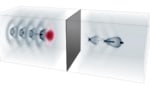
New electron accelerator combines laser and plasma wakefield techniques
Through their latest experiments, the researchers discovered a further advantage of their approach. “We found that in some cases, not only can the laser be guided, it can also generate a wakefield inside the curved channel and accelerate electrons,†Chen explains. “Usually these were only found in a straight plasma channel. It means both laser and high energy electrons can be guided in such curved plasma channel.â€
The team believes that its early results are an important milestone. “Our experiment shows how relativistic electrons can be stably guided by a curved plasma channel, which is the critical step of our staged wakefield acceleration scheme,†Chen says. “In the future, such channels could be used for wakefield acceleration and electron guiding.â€
If they can demonstrate higher numbers of acceleration stages using multiple curved channels, Zhang’s team hope that teraelectronvolt energies may one day be within reach for LWFAs at just a fraction of the size and cost of modern particle accelerators. “For the moment, we can say our study solves a critical step for staged laser wakefield acceleration and shows the potential for a compact synchrotron radiation source,†Chen says.
The research is described in Physical Review Letters.