

Close Menu
Chicago News Journal
    Facebook X (Twitter) Instagram
    • Contact us
    • About us
    • Amazon Disclaimer
    • DMCA / Copyrights Disclaimer
    • Privacy Policy
    • Terms and Conditions
    Facebook X (Twitter) Instagram YouTube TikTok
    Chicago News JournalChicago News Journal
    • Home
    • US News
    • Politics
    • Business
    • Science
    • Technology
    • LifeStyle
    • Music
    • Television
    • Film
    • Books
    • Contact
      • About us
      • Amazon Disclaimer
      • DMCA / Copyrights Disclaimer
      • Privacy Policy
      • Terms and Conditions
    Chicago News Journal
    Home»Science

    No-heat quantum engine makes its debut

    AdminBy AdminOctober 5, 2023 Science
    Facebook Twitter Pinterest LinkedIn Tumblr Email Reddit Telegram


    Artist's cartoon of the quantum engine as a piston, showing the piston compressed when the particles are molecules and expanded when they are individual fermionic atoms
    In and out: An illustration of the quantum engine as a piston, showing the piston compressed when the particles in the gas exist as bosonic molecules and expanded when they are individual fermionic atoms. (Courtesy: Miriam Neve)

    Most regular engines convert thermal energy into mechanical work, but an international team of researchers has now designed and implemented an entirely different, quantum engine. Instead of heat, this proof-of-principle microscopic engine runs on the energy difference associated with the statistical properties of quantum matter. And rather than powering the next generation of cars, this type of engine may one day be used to charge quantum batteries or power quantum computers and sensors.

    “Engineering is going into the nano world, and at some point, quantum will hit,” says Artur Widera, a physicist at the University of Kaiserslautern, Germany and a leader of the collaboration. “And we’d better be prepared and know what’s going on and how we can use it.”

    The power of quantum statistics

    All particles known to science fall into one of two categories: bosons or fermions. While bosons cluster in the same quantum state, fermions obey the Pauli exclusion principle, meaning no two fermions can share the same state. This doesn’t matter much at room temperature when particles are flying about at high speeds. Cool those particles down to just shy of absolute zero, though, and the difference becomes vast: the bosons pile into the lowest available energy state, while fermions stack on top of each other in a “ladder” of states. At such low temperatures, a collection of fermions will thus have much more energy than a collection of bosons.

    “When I was a student in class, and I saw what enormous energies are associated with a Pauli principle, I was wondering, ‘can you use this?’” Widera says.

    At the time, the answer was “no”. Although the energy difference between bosons and fermions at low temperatures is immense, switching a set of particles from bosonic to fermionic behaviour was out of reach. Then, in the early 2000s, physicists discovered that if they cooled a gaseous cloud of fermionic atoms to just above absolute zero and then tuned the magnetic field surrounding them, they could force the atoms to pair up into bosonic molecules. “Suddenly, you have a tool to really change the quantum statistics,” Widera says.

    A quantum Pauli engine

    The so-called quantum Pauli engine Widera and his collaborators developed relies on this boson-fermion switchover and operates similarly to a regular piston-based engine. The difference is that instead of ignition and heat pushing the piston out, the driving force is the change in the gas’ fundamental quantum nature.

    To realize the engine, the team cooled a gas of fermionic lithium-6 atoms and confined them in a combined optical and magnetic trap. They then tuned the magnetic field until the fermionic atoms paired up into bosonic molecules. The operation of the engine was a four-step process akin to the four strokes of a piston engine: a compression step (closing the piston), a “fermionization” step (instead of ignition), an expansion step (instead of pushing the piston out) and “bosonization” (resetting back to the starting point).
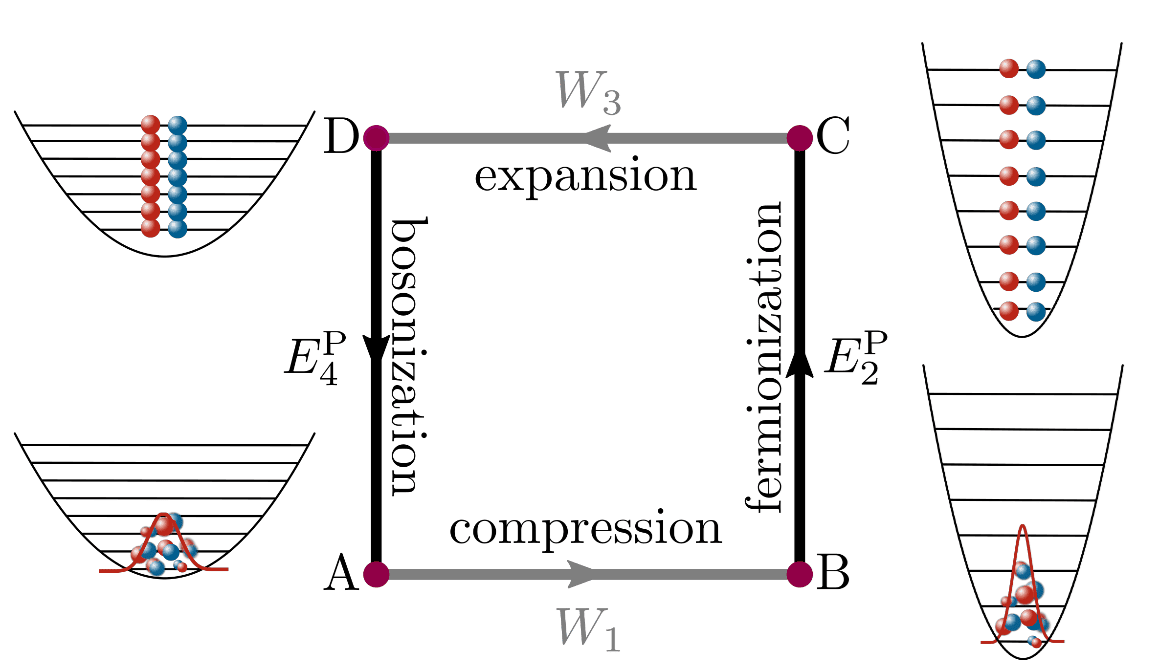
    Diagram showing the positions of atoms in energy levels at each stage of the quantum engine's operation
    Four strokes of a quantum engine: First, bosonic lithium molecules are compressed in a trap. Second, the magnetic field is changed to break up the molecules, leaving fermionic lithium-6 atoms. Third, the trap is expanded, which could allow the atoms to do work on their environment. Lastly, the magnetic field is changed back, forming molecules and resetting the system. (Courtesy: Jennifer Koch and Artur Widera, Department of Physics and Research Center OPTIMAS, RPTU Kaiserslautern-Landau)

    The efficiency of this engine is set by the difference in the gas’s energy change in the first (compression) step and the energy increase in the third (expansion) step. In this experiment, the researchers achieved a maximum efficiency of 25%, but the team say further improvements could bring that number above 50%. This number does not include the energy it takes to run the apparatus for cooling the atoms and keeping them trapped. But it does reflect the work that’s directly put into the gas, and the work that could be extracted from it.

    Extracting power: a work in progress

    In this version of the engine, the “piston” is effectively welded shut, since the trap confining the gas of atoms or molecules cannot be pushed open. This means the engine does not actually do work on the outside world. Instead, its calculated work and efficiency reflect how it could perform in principle, though the team is trying to figure out a way to make it do practical mechanical work.

    zoom-1-light

    Physicists create quantum phase battery


    Even though this is a proof-of-concept demonstration, Ferdinand Schmidt-Kaler, a physicist at Johannes Gutenberg University in Mainz, Germany who was not involved in the work, believes it is an essential step. “We need such clean showcase experiments to display and study the quantum effects in heat engines,” he tells Physics World. “Works like this are stimulating both new experimental directions and a better theoretical understanding. On the other hand, I am very confident that quantum thermodynamics will be an essential ingredient on every quantum computer, of many quantum sensors in less than 10 years.”

    Share. Facebook Twitter Pinterest LinkedIn Tumblr Email Reddit Telegram

    You might also be interested in...

    Inventors of optogenetics win Nobel Prize in Physiology or Medicine – Physics World

    October 6, 2026

    Rethinking risk with electronics for space

    October 5, 2026

    how are researchers making weather predictions more accurate? – Physics World

    October 4, 2026

    World Space Week 2026 Celebrates the “Rocket Revolution” 

    October 3, 2026

    Festival season finds Quantum Software Lab in high spirits – Physics World

    October 2, 2026

    AI Apocalypse? By Howard Bloom

    October 2, 2026
    Popular Posts

    AstraZeneca CEO says Summit drug could drive future cancer combos

    FLO announce 2027 UK, European and North American tour

    Trump approves firing squad execution of Fort Hood killer Hasan: Pentagon

    6 Literary Fiction Books About Complicated Choices

    Dress Code: Deck | FashionBeans

    ‘Survivor’ Alum Wanted After Disappearance Of Son

    Categories
    • Books (2,375)
    • Business (3,354)
    • Events (32)
    • Film (258)
    • LifeStyle (2,842)
    • Music (2,710)
    • Politics (2,275)
    • Science (1,893)
    • Technology (1,788)
    • Television (4,289)
    • Uncategorized (3)
    • US News (3,205)
    Archives
    Useful Links
    • Contact us
    • About us
    • Amazon Disclaimer
    • DMCA / Copyrights Disclaimer
    • Privacy Policy
    • Terms and Conditions
    Popular Posts
    • OnePlus Buds Ace 2 With 12.4mm Drivers, Up to 43 Hours Total Battery Life Launched: Price, FeaturesOnePlus Buds Ace 2 With 12.4mm Drivers, Up to 43 Hours Total Battery Life Launched: Price, Features
    • TV’s Most Regrettable Farewells: Characters We Never Wanted to LoseTV’s Most Regrettable Farewells: Characters We Never Wanted to Lose
    • Movie Review: ‘Wallace & Gromit: Vengeance Most Fowl’Movie Review: ‘Wallace & Gromit: Vengeance Most Fowl’
    • CHIPS Act last  billion in semiconductor award moneyCHIPS Act last $6 billion in semiconductor award money
    • Must-Read Working Class NonfictionMust-Read Working Class Nonfiction
    Archives
    Categories
    • Books
    • Business
    • Events
    • Film
    • LifeStyle
    • Music
    • Politics
    • Science
    • Technology
    • Television
    • Uncategorized
    • US News
    Facebook X (Twitter) Instagram YouTube TikTok
    © 2026 Chicago News Journal. All rights reserved. All articles, images, product names, logos, and brands are property of their respective owners. All company, product and service names used in this website are for identification purposes only. Use of these names, logos, and brands does not imply endorsement unless specified. By using this site, you agree to the Terms of Use and Privacy Policy.

    Type above and press Enter to search. Press Esc to cancel.