


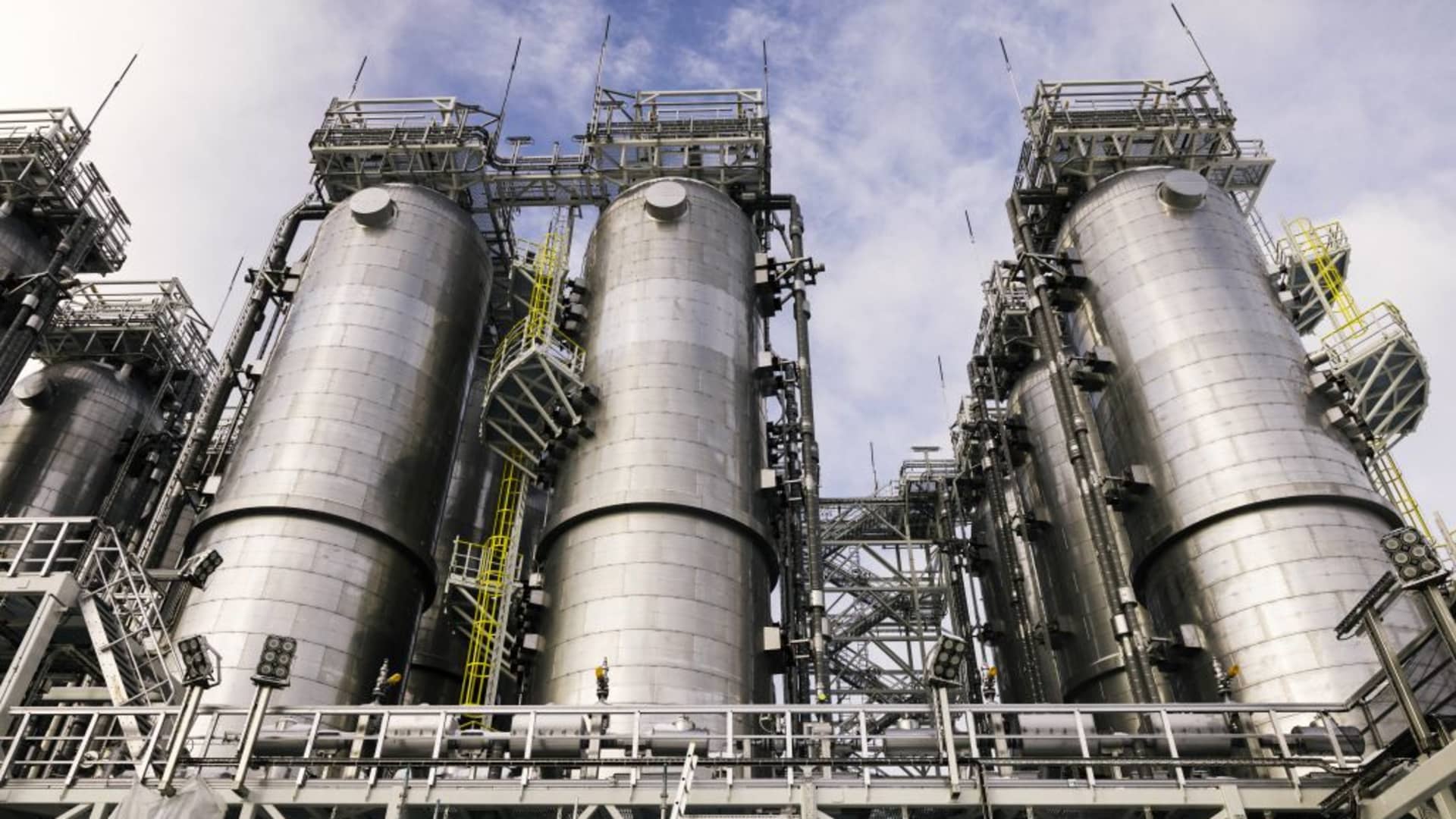
The receiving dock at the Northern Lights carbon capture and storage project, controlled by Equinor ASA, Shell Plc and TotalEnergies SE, at Blomoyna, Norway, on Friday, Jan. 19, 2024.
Bloomberg | Bloomberg | Getty Images
Norway’s government wants to show the world it is possible to safely inject and store carbon waste under the seabed, saying the North Sea could soon become a “central storage camp” for polluting industries across Europe.
Offshore carbon capture and storage (CCS) refers to a range of technologies that seek to capture carbon from high-emitting activities, transport it to a storage site and lock it away indefinitely under the seabed.
The oil and gas industry has long touted CCS as an effective tool in the fight against climate change and polluting industries are increasingly looking to offshore carbon storage as a way to reduce planet-warming greenhouse gas emissions.
Critics, however, have warned about the long-term risks associated with permanently storing carbon beneath the seabed, while campaigners argue the technology represents “a new threat to the world’s oceans and a dangerous distraction from real progress on climate change.”
Norway’s Energy Minister Terje Aasland was bullish on the prospects of his country’s so-called Longship project, which he says will create a full, large-scale CCS value chain.
“I think it will prove to the world that this technology is important and available,” Aasland said via videoconference, referring to Longship’s CCS facility in the small coastal town of Brevik.
“I think the North Sea, where we can store CO2 permanently and safely, may be a central storage camp for several industries and countries and Europe,” he added.
Storage tanks at the Northern Lights carbon capture and storage project, controlled by Equinor ASA, Shell Plc and TotalEnergies SE, at Blomoyna, Norway, on Friday, Jan. 19, 2024.
Bloomberg | Bloomberg | Getty Images
Norway has a long history of carbon management. For nearly 30 years, it has captured and reinjected carbon from gas production into seabed formations on the Norwegian continental shelf.
It’s Sleipner and Snøhvit carbon management projects have been in operation since 1996 and 2008, respectively, and are often held up as proof of the technology’s viability. These facilities separate carbon from their respective produced gas, then compress and pipe the carbon and reinject it underground.
“We can see the increased interest in carbon capture storage as a solution and those who are skeptical to that kind of solution can come to Norway and see how we have done in at Sleipner and Snøhvit,” Norway’s Aasland said. “It’s several thousand meters under the seabed, it’s safe, it’s permanent and it’s a good way to tackle the climate emissions.”
Both Sleipner and Snøhvit projects incurred some teething problems, however, including interruptions during carbon injection.
Citing these issues in a research note last year, the Institute for Energy Economics and Financial Analysis, a U.S.-based think tank, said that rather than serving as entirely successful models to be emulated and expanded, the problems “call into question the long-term technical and financial viability of the concept of reliable underground carbon storage.”
‘Overwhelming’ interest
Norway plans to develop the $2.6 billion Longship project in two phases. The first is designed to have an estimated storage capacity of 1.5 million metric tons of carbon annually over an operating period of 25 years — and carbon injections could start as early as next year. A possible second phase is predicted to have a capacity of 5 million tons of carbon.
Campaigners say that even with the planned second phase increasing the amount of carbon stored under the seabed by a substantial margin, “it remains a drop in the proverbial bucket.” Indeed, it is estimated that the carbon injected would amount to less than one-tenth of 1% of Europe’s carbon emissions from fossil fuels in 2021.
The government says Longship’s construction is “progressing well,” although Aasland conceded the project has been expensive.
“Every time we are bringing new technologies to the table and want to introduce it to the market, it is having high costs. So, this is the first of its kind, the next one will be cheaper and easier. We have learned a lot from the project and the development,” Aasland said.
“I think this will be quite a good project and we can show the world that it is possible to do it,” he added.
Workers at an entrance to the CO2 pipeline access tunnel at the Northern Lights carbon capture and storage project, controlled by Equinor ASA, Shell Plc and TotalEnergies SE, at Blomoyna, Norway, on Friday, Jan. 19, 2024.
Bloomberg | Bloomberg | Getty Images
A key component of Longship is the Northern Lights joint venture, a partnership between Norway’s state-backed oil and gas giant Equinor, Britain’s Shell and France’s TotalEnergies. The Northern Lights collaboration will manage the transport and storage part of Longship.
Børre Jacobsen, managing director for the Northern Lights Joint Venture, said it had received “overwhelming” interest in the project.
“There’s a long history of trying to get CCS going in one way or another in Norway and I think this culminated a few years ago in an attempt to learn from past successes — and not-so-big successes — to try and see how we can actually get CCS going,” Jacobsen told CNBC via videoconference.
Jacobsen said the North Sea was a typical example of a “huge basin” where there is a lot of storage potential, noting that offshore CCS has an advantage because no people live there.
A pier walkway at the Northern Lights carbon capture and storage project, controlled by Equinor ASA, Shell Plc and TotalEnergies SE, at Blomoyna, Norway, on Friday, Jan. 19, 2024.
Bloomberg | Bloomberg | Getty Images
“There is definitely a public acceptance risk to storing CO2 onshore. The technical solutions are very solid so any risk of leakage from these reservoirs is very small and can be managed but I think public perception is making it challenging to do this onshore,” Jacobsen said.
“And I think that is going to be the case to be honest which is why we are developing offshore storage,” he continued.
“Given the amount of CO2 that’s out there, I think it is very important that we recognize all potential storage. It shouldn’t actually matter, I think, where we store it. If the companies and the state that controls the area are OK with CO2 being stored on their continental shelves … it shouldn’t matter so much.”
Offshore carbon risks
A report published late last year by the Center for International Environmental Law (CIEL), a Washington-based non-profit, found that offshore CCS is currently being pursued on an unprecedented scale.
As of mid-2023, companies and governments around the world had announced plans to construct more than 50 new offshore CCS projects, according to CIEL.
If built and operated as proposed, these projects would represent a 200-fold increase in the amount of carbon injected under the seafloor each year.
Nikki Reisch, director of the climate and energy program at CIEL, struck a somewhat cynical tone on the Norway proposition.
“Norway’s interpretation of the concept of a circular economy seems to say ‘we can both produce your problem, with fossil fuels, and solve it for you, with CCS,'” Reisch said.
“If you look closely under the hood at those projects, they’ve faced serious technical problems with the CO2 behaving in unanticipated ways. While they may not have had any reported leaks yet, there’s nothing to ensure that unpredictable behavior of the CO2 in a different location might not result in a rupture of the caprock or other release of the injected CO2.”
Read the original article here