


For the first time, a researchers has described how it would “feel†to touch a quantum superfluid. Through new experiments, Samuli Autti and colleagues at the UK’s Lancaster University concluded that an ultracold helium-3 superfluid would feel like a heat-conducting 2D surface that encloses an empty bulk.
Superfluidity is a remarkable consequence of quantum mechanics that occurs at ultracold temperatures. Near absolute zero, some fluids will undergo a transition to a zero-viscosity state and can flow forever with zero resistance.
Superfluidity was first observed in helium-4 way back in 1937 and today it is also studied in ultracold atomic gases called Bose–Einstein condensates. But perhaps the most interesting superfluid discovery came in 1970, when three American physicists showed that helium-3 can also become a superfluid – albeit at much lower temperatures than helium-4.
Pairing-up
Unlike helium-4, which is a boson that is prone to condensing into a superfluid, helium-3 is a fermion that should not exhibit superfluidity. However, at very low temperatures, helium-3 atoms pair-up to form bosons, which can then form a superfluid.
This complicated process means that the physics of superfluid helium-3 is much richer than that of helium-4. For example, a helium-3 superfluid exists in two distinct phases: an isotropic “A phase†and an anisotropic “B phaseâ€, which are defined in terms of the relative orientations of the spins of the paired atoms.
The B phase occurs at lower temperatures and involves a spin-triplet configuration. The superfluid reacts to external stimuli via the splitting of pairs, creating quasiparticles that conduct heat through the B phase.
However, the density of these quasiparticles drops drastically as the superfluid cools. At temperatures lower than about 1 mK, the fluid’s interior can only conduct heat efficiently from sources hot enough to create new quasiparticles. Until now, researchers have not considered how this property would affect the macroscopic mechanical behaviour of the B phase.
Mechanical breakdown
One particularly interesting question involves the superfluid’s mechanical breakdown. “Traditionally, superfluids are believed to break down if you hit them hard enough with a mechanical probe,†Autti explains. “How the breakdown happens sounds like a simple question, but it has remained an open problem in superfluid helium.â€
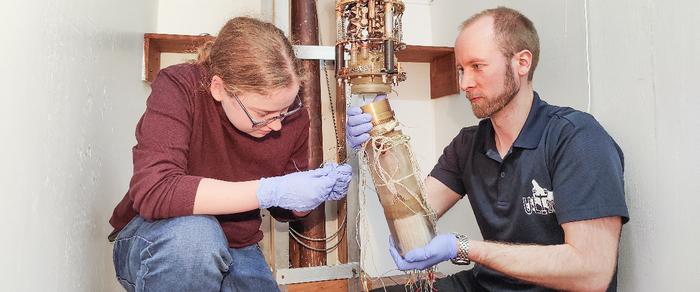
To explore this further, Autti’s team designed an experiment where a B-phase helium-3 superfluid is probed by a vibrating, goalpost-shaped wire. As it moves back and forth, the heat introduced by the wire’s crossbar creates new quasiparticles in the superfluid.
“We carefully analysed this heat signature by moving the probe rod in the superfluid, which allowed us to reconstruct the interaction between the probe and the superfluid,†Autti explains.
The researchers discovered that no heat at all is conveyed by the interior bulk of the superfluid. Instead, the quasiparticles are confined to the edges of the container, so any heat generated by the probe is transported along the surface.
Surface superfluid
“At the lowest temperatures, bulk superfluid helium-3 is surrounded by an independent two-dimensional superfluid phase,†explains Autti. “This superfluid has its own heat transport, and primarily interacts with probes inserted in the bulk.â€
This effect has some especially interesting consequences for the superfluid’s mechanical properties. “It turns out the bulk superfluid did not break; it remained passive no matter how hard we tried,†Autti continues.

Sound waves in fermionic superfluid are studied in a ‘beautiful’ experiment
“Instead, we learned that the probe was only interacting with a very, very thin, essentially two-dimensional system that covers the probe. Even more unexpectedly, a closer look revealed that this layer was carrying heat around rather effectively while the bulk played no role in the heat flow.â€
From this discovery, the team could predict for the first time how such a superfluid would feel to the touch. In stark contrast to a classical fluid, they concluded that the interior bulk of superfluid helium-3 would feel empty, like moving your fingers through a vacuum. Since heat is conveyed across the superfluid’s surface, touching it would feel like pushing into a thin, 2D material, with heat flowing along your fingers.
This discovery marks a breakthrough in our understanding of the macroscopic properties of superfluid helium-3, and it could have important implications for fields ranging from particle physics to cosmology, where exotic quantum fluids are widely studied. “ I think we can safely assume that our view of basic physics elsewhere will change due to these findings in superfluid helium-3,†Autti says.
The research is described in Nature Communications.