


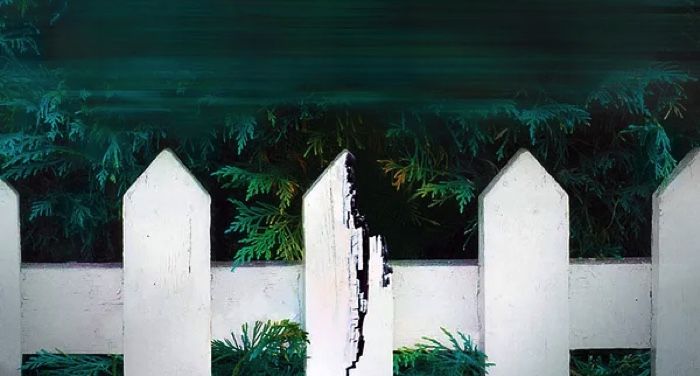
The white picket fence is a commonly used bit of symbolism. It’s the American Dream. Or suburbia. Or whiteness. Or a happily ever after. Or suffocating homogeneity. Or are those all being used interchangeably?
I find it interesting how this seemingly arbitrary bit of lawn design can have so much meaning packed into it, especially when that meaning changes depending on the context. A white picket fence appears on the covers of suburban thrillers, on horror movie posters, and in the happily ever after scenes of romance novels. But before we get into how its symbolism can transform, let’s take a step back to scrutinize this everyday object.
Picket comes from the French word piquet, meaning a sharpened stick or board. They were used by American colonists to defend land. Once they became easier to mass produce in the late 1800s, they started to be used in yards, where they stayed popular until the ’30s. By the 1950s, they’d been replaced by chain link fences, though they stuck around as a symbol of Americana and had a resurgence of popularity in the 1980s.
Already, this is a fascinating start to a symbol of the good life, and almost too on the nose for a representation of suburban America. The pointed tops of these fences are an echo of the violence that underpins the history of the U.S.: this land was taken by force from its original inhabitants. The symbol of the white picket fence also harkens back to a time that never existed: the real 1950s suburbia had chain link fences, but they’ve been replaced in our collective imagination with white picket fences. This erasure of the dark parts of its history and the invention of an idealized past is all part of the dream of American life the white picket fence represents.
A fence is inherently meant to divide people, keep unwanted visitors away from your home, and prevent pets and children from leaving it. And yet, somehow this tool of division, which comes out of the aftermath of violent colonialism, is a stand-in for the American Dream. There’s a tension within the white picket fence: it keeps people out, but the spread-out slats allow you to see between them. You can even have conversations through it. A metal fence with sharpened spikes at the top is a clear “keep out” signal, but the wooden equivalent doesn’t send the same message. Besides, picket fences are often too short to prove a real deterrent — sometimes they’re only knee-height.
I think this is a perfect symbol of the tension in suburbia: the desire to believe you have some kind of community and positive relationship with your neighbors, while also wanting to maintain some division and security measures. These fences are a performance of security that isn’t a response to any real danger.
Of course, we can’t talk about the white picket fence without discussing whiteness. Aside from the literal — a white fence is a sign of wealth because it’s more expensive to maintain than the natural wood — there’s also a strong association between suburbia and whiteness, especially due to the history of redlining, which explicitly created systems to keep people of color out of the suburbs.

White picket fences are common across the U.S. (and many other countries), so it’s not a surprise that they show up in media. What I’m interested in is how the symbolic function of a white picket fence changes depending on the genre.

In suburban or domestic mysteries and thrillers, a white picket fence isn’t just a convenient shorthand for suburbia. It also works as a contrast between the promises of suburbia — the perfect marriage with 2.5 kids, the friendly neighbors, the prosperity — and the darker truths that come out in these plots. Fences keep people out and they keep people in: they can symbolize the secrets going on behind closed doors. Often, the white picket fences themselves are damaged on the cover, showing the breakdown of the characters’ supposed American Dream.
In a young adult coming-of-age novel, the white picket fence holds onto its meaning of the suburban American Dream, but the connotation is completely different. Whereas in a romance, the white picket fence is the happily ever after to fight to finally achieve at the end, for suburban teens in coming-of-age novels, it’s suffocating. It comes with rigid expectations of conformity. In a young adult novel, white picket fences are something to escape from.

Take the contrast between the American Dream and its reality from domestic thrillers and the trapped feeling from a coming-of-age story and turn it up to 11, and you have the white picket fence in horror novels.
I’m reminded of a horror coming-of-age novel that made an indelible impression on me as a kid: Ginger Snaps. In one scene, the main character stages her death by impaling on a white picket fence for a photo project, casually flipping the bird to the camera. For her, suburban life, with all its expectations about normalcy, is the horror show. In the Cujo movie poster, the title drips blood down a white picket fence.
Some horror, like Shirley Jackson’s suburban gothic stories, expose the darkness at the heart of white suburban life: the bigotry that rots beneath the whitewashed facade and is sure to emerge eventually. In other horror novels, the white picket fence provides a pristine backdrop to the hellish horror premise — how could something so terrible be happening here, where everything is supposed to be safe and prosperous?
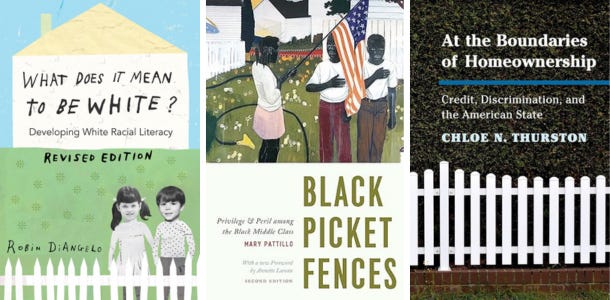
It’s worth noting the book covers included in this article are mostly by white authors. The books by authors of color that employ white picket fences as symbolism are usually explicitly about race and racism in home ownership, while many of the books that include white picket fences by white authors ignore this essential element of its symbolism.
That’s my take on the meaning of white picket fences across genres, whether on book covers or between them, but I’d love to hear your thoughts in the comments about the different uses of this common piece of symbolism!
Find more posts like this via our subscription publication, The Deep Dive! Weekly staff-written articles are available free of charge, or you can sign up for a paid subscription to get additional content and access to community features.
Read the original article here