


Jiordan Castle’s memoir-in-verse Disappearing Act follows the teen-version of herself as she lives through the arrest, court proceedings, and subsequent incarceration of her father while navigating the fraught years of the transition from girlhood to adolescence. Through mostly narrative poems‚ Castle invites us into her world as it’s changing faster than her mind can keep up.
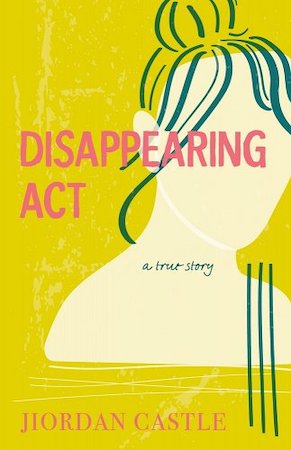
The book’s dedication—”For me then, and for you now” —immediately signals to the reader a rare intimacy; that we will be led—sometimes smiling, sometimes wincing—into a moment in time not often shared beyond the performed facade of the nuclear family. Disappearing Act begins mid-story—following an FBI raid, Jiordan’s father’s suicide attempt, bad news from the attorney, Jiordan’s refuge with her best friend and their endless online personality quizzes (it being the early aughts)—the book progresses in a mostly chronological order.
In books about prison and “crime,” readers often desire—feel entitled to, even—grizzly details (look no further than the proliferation of true-crime podcasts and TV series). Castle deftly subverts this expectation: in Disappearing Act, we learn more context than content—her father’s mood swings; her mother’s torn support; her older sisters’ balancing of their own lives—though the reader does get a vague understanding that the father is guilty and the crime is money-related. This is not an attempt to hide or minimize the father’s actions, but is instead mimetic of a teenager toggling dizzyingly between an “adult,” “mature” perspective and the innocent confusion, sadness, anger, and helplessness of a young child.
Castle and I discussed her experience of crafting this book from painful memories; the role of the self in grand themes of “crime” and “punishment,” and how she navigated the personal and the secret when disclosing sensitive information.
Leigh Sugar: Disappearing Act is written in the voice of an early teenage you. What was it like writing the then-you, as the now-you?
Jiordan Castle: I have this sense of an inner child and a secret self when I write about myself, my life, no matter the when or the topic. To pull something not too grisly from True Detective, I think time, to me, probably is a flat circle. The person who lived this book is also the person who wrote it, but in time traveling through memory, I got to look at the character of myself as a kind of younger sister. I got to be generous and real and mean and thoughtful about the realities of coming of age in a way you can’t when you’re in it.
LS: That’s so interesting to me, because I realized recently I don’t have a strong connection to my inner child; I don’t really experience my life as continuous; it feels very disconnected. How did you get yourself in—and especially, out—of that inner-child/secret self headspace?
In time traveling through memory, I got to look at the character of myself as a kind of younger sister.
JC: For most of us, I think the hard-hearted memories live right at the surface. But that’s not all there is. I remember the funniest things, the sweet things. And when you’re a child, you’re feeling everything for the first time. Everything is, in some sense, the end of the world. And the beginning of a new one. I still feel that about that time, so it was easy enough for me to drop into character in a way and let myself feel the too-much-ness of that time. I remember presents and fights and how certain shirts looked and felt.
It also helped for me to create a playlist from that time in my life, and a playlist that’s more like what writing the book felt like to me. Having the two in conversation with each other is something special.
LS: What is different about this version than, say, a version for an “adult” audience?
JC: It’s so complicated because I do consider this book to be what I call “YA+” as if it’s for young adults and the dot dot dot of adults reconnecting with that version of themselves. Because this story still lives in me, I know it lives in other adults with similar experiences. The people I love talking to now, after readings, are teenagers who have a loved one in prison or have a friend who does, but also mother-daughter pairings. I find that so interesting. And it reminds me that maybe if we just allowed ourselves—and each other—to love what we love in earnest, without shame or bias, we would come to a place of more “we” than “I.” I’m looking for that “we” more and more these days.
I can’t ignore the fact though that if I had written, let’s say, a chronological, prose memoir looking back at the past in past tense—an adult lens on a teen experience—I would have a radically different book. I can’t say whether it would be better or worse (or whatever that means), but I do think it would pull me as the narrator further from the story I most wanted to convey.
LS: A bit off topic but… do the words “better” or “worse,” in terms of writing, mean anything to you? If so, what? If not, why?
JC: So, I used to fancy myself only a baker, but over the years I’ve felt more naturally like a cook. Sauce, salt, an imprecise, rolling boil — all of it easier and also less than what it takes for me to measure and trust the spice level in a cake. I like the rhythm I can get into in cooking, how I can be early or late with ingredients and still end up okay. It can resemble the picture in my mind or produce a new one. With baking, you forget the baking powder and it can be over, just like that. But you learn. Sometimes it’s good to go for the gold with a loaf of banana bread and know I nailed it because I paid attention, I abided by the rules of science. Other times, I like the madness of throwing things in a pot. Both are true for me as a writer.
Sometimes I needed to treat a haunted house like a museum.
I become a better writer (and cook!) by trying, by doing. I have bad writing, I have good writing. And it’s okay. The power and privilege of allowing ourselves both, all in service of art and sharing it, whether it’s just with ourselves or an audience.
LS: Ok, back to memoir/memoir-esque related questions. How did you wrangle your mind to the place of deep memory in order to recall events and craft the narrative, especially when those memories were painful or traumatic?
JC: When I felt stuck in the murk or like a villain for writing the book at all, like a traitor to my original home team, I forced myself to think of the you I was writing for — that big picture of me then and you now. I needed this book to be in service of something bigger than myself, and sort of pinching myself awake to that realization over and over helped me focus when I got bogged down in the painful parts. Sometimes I needed to treat a haunted house like a museum. A sort of look but don’t touch mentality, to have a feeling or a memory, without letting it have me.
Much easier said than done though, and honestly, sometimes I just… you know, I ate a cupcake. I took a walk. I pet my dog. I hugged my husband. I called a friend. The book is a time capsule, not a live account of my feelings, but I had to remind myself of that. I still do.
LS: Did anybody discourage you from publishing this book, and how did you make your own decisions about what you’re “allowed” to write and share?
JC: Unless you’re a public figure, probably no one is going to ask you to write a memoir. Chances are you’re doing something that goes against, period. I’ve said before that every character in my story, my book and my life, is the main character in theirs. I wanted to treat them with respect, compassion, and nuance, but I’m only one lens. I’m only me. Trying and failing and trying again to walk that line is the best I could do.
But part of the reason Disappearing Act isn’t a novel instead is because I own this experience. I want to own this experience. I was lonely for people to share it with when I was young. If even one person reads my book and feels less alone or more known, a hint that there’s another side to the mountain they’re climbing, that’s enough. That’s my peace.
LS: Oof, the loneliness piece I very much relate to. You and I are both White Jewish women, and as such are not a demographic typically thought of when we discuss incarceration and related topics. I’m not sure what the question is here, but I wanted to name that reality, and all the privileges—and loneliness—that can come with it. Do you have any more thoughts about how your particular intersectional identities affected (and continue to affect) your experience with the criminal legal system?
JC: Yes! This is one of the many reasons I’m grateful to be talking to you about this. I hope to help people who aren’t having conversations about prison have conversations. And for young people affected by incarceration for the first time, with so little control, to have even one adult voice validating their experience. That’s something I can do from my niche position.
Time doesn’t heal all wounds. Sometimes it stuns you into silence.
For people of color, it’s always been exponentially easier to become incarcerated and stay that way. There’s too much to say here, but the socioeconomic breakdown, the poverty to prison pipeline, is very real—and also not my personal experience. I was lonely for peers with a family member in prison when I was young, and it’s not that thousands of them didn’t exist. It’s that we didn’t talk about it, didn’t have as much access to online communities like ours, and that the majority of kids with any such experience didn’t look like me. I want us to keep talking about that.
LS: What is (or has been) the hardest aspect of your experience to communicate in your writing?
JC: In this book, it’s probably how much love went into my family. Even when I hated us or we hated each other. I was young! Time doesn’t heal all wounds. Sometimes it stuns you into silence. Sometimes it gives you perspective. I was born into this pack of wolves and they were mine and I was theirs. Nothing erases that and, at least for me, nothing should. You write a book, you break a kind of code. I know that. It’s hard to communicate what that code consisted of and what it consists of now. I also think that a memoir really is a story, a past tense, a time capsule — and not a smoking gun, a live feed, or the world as I know it now.