


Mars’ supersize Valles Marineris — the largest known canyon in the solar system — is still tectonically active even though the Red Planet is geologically “dead,” new research on a previously record-breaking marsquake reveals.
On Aug. 25, 2021, NASA‘s InSight lander, which touched down on the Red Planet in 2018, detected a powerful marsquake, designated S0976a. The Martian equivalent of an earthquake reached magnitude 4.2, which, at the time, was the most powerful quake that InSight or any other Mars lander had ever seen. (Since then, a 4.7 magnitude marsquake in May 2022 knocked it off the top spot, but S0976a remains second on this list.)
Unlike most marsquakes, which have been minor tremors triggered by meteorite impacts near InSight, S0976a was a deep rumble that originated from the opposite side of Mars as the robotic seismologist, in the western half of Valles Marineris.
In the new study, published Oct. 15 in the journal Nature Communications, researchers reanalyzed the seismic wave data of S0976a and found that the quake originated from within a fault line running below the enormous canyon. The most likely explanation, they argue, is that there was tectonic movement in this hidden crustal crack.
“Valles Marineris is one of the most spectacular geological structures anywhere in the solar system, but until now we didn’t know for certain that its faults are still active,” study first author Jung-Hun Song, a researcher in the Department of Earth Science and Engineering at Imperial College London, said in a statement. “What we see is that this is not just a ‘dead’ fossil landscape, as faults deep beneath the canyon can still slip and generate marsquakes, long after the geological processes that originally formed them have ceased.”

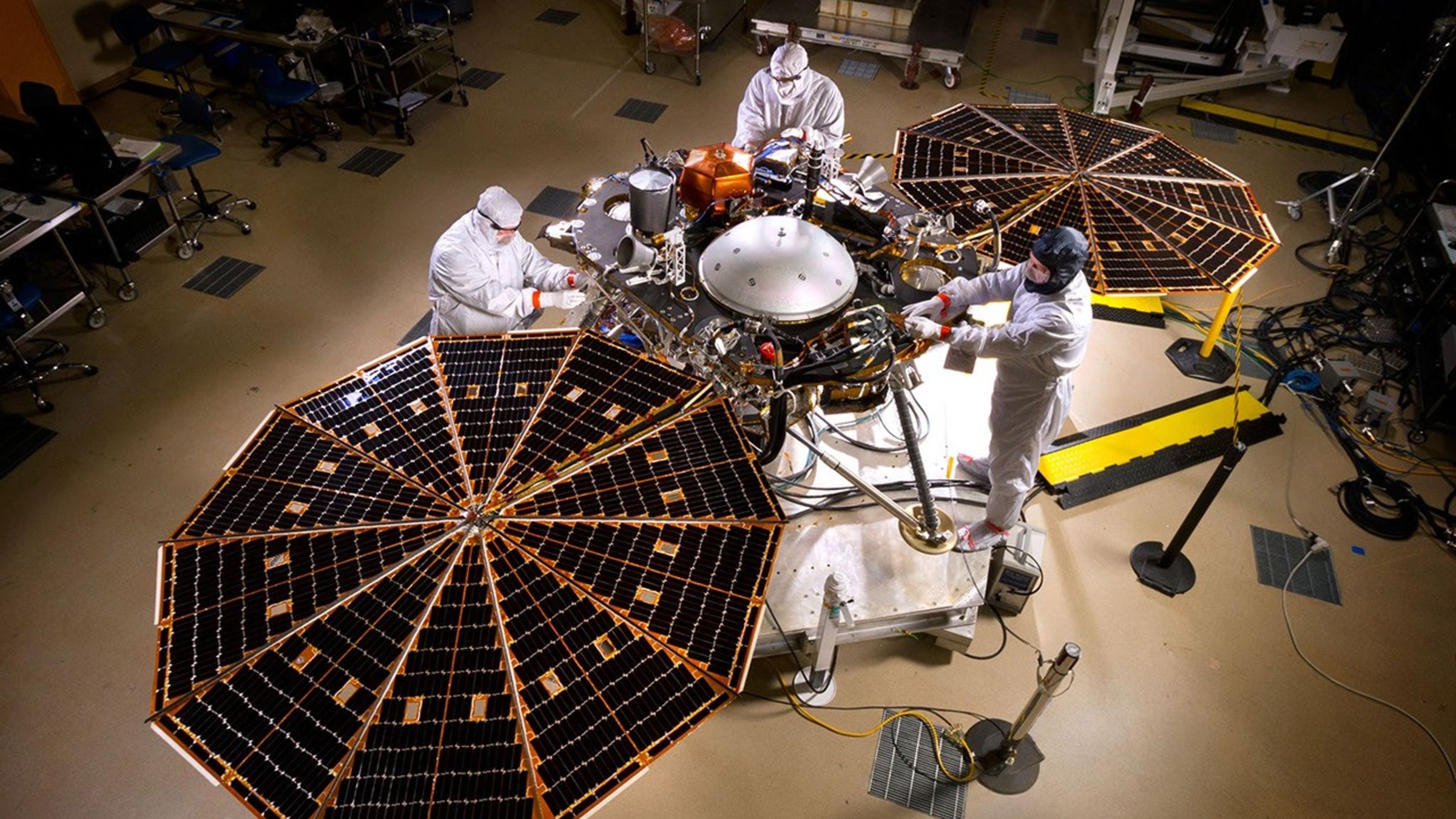
S0976a is the second-largest marsquake ever detected by NASA’s InSight lander, shown here in a NASA clean room on April 30, 2015.
(Image credit: NASA/JPL-Caltech/Lockheed Martin)
A geologically “dead” world
Valles Marineris is an enormous set of interconnected gullies and ravines stretching up to 2,500 miles (4,000 kilometers) in length, or roughly 10 times longer than the Grand Canyon. It is also up to 20 times wider and five times deeper, meaning that if you found yourself stranded at the bottom, it could take you a couple of months to climb out again.
The enormous chasm — named after the Mariner 9 spacecraft, which helped discover it in 1971 — is clearly visible from space, like a giant scar carved into the Red Planet’s face. From orbit, you would also see the nearby Tharsis region, which is home to Mars’ giant volcanoes, including Olympus Mons, which is at least three times taller than Mount Everest.
Get the world’s most fascinating discoveries delivered straight to your inbox.
These imposing structures are proof that Mars was once geologically active, perhaps even more so than Earth. However, scientists think the Red Planet’s surface has remained relatively unchanged for nearly 3 billion years, according to the European Space Agency.

Valles Marineris is almost as long as the continental U.S. is wide. (In this photo, captured by NASA’s Mars Odyssey orbiter, an optical illusion known as relief inversion may make the canyon appear as if it is raised above the surface, which it is not.)
(Image credit: NASA/JPL-Caltech/ASU)
The reason for this is twofold. First, Mars is smaller than Earth, so its core and mantle have cooled much faster than our planet’s and are, therefore, less dynamic. Second, Mars has no tectonic plates. Instead of giant patches of crust butting against each other, the Red Planet’s outermost layer is almost completely intact and acts like a giant lid over its cooling molten innards. (Research published earlier this week throws the “dead” theory into question, hinting that magma may still lurk below dormant Martian volcanoes).
Despite this, Mars still has fault lines. But rather than being a boundary between tectonic plates, these lines are more like giant cracks in its crust, some of which are visible at the surface.
Signs of tectonic life
In the new study, researchers discovered proof of what they call a slip-strike marsquake, where “blocks of crust move horizontally past one another along a steep, deeply rooted fault,” the team said. They believe this occurred somewhere between 12 and 25 miles (20 to 40 km) below Valles Marineris.
The researchers also simulated several other potential causes of the marsquake, including a major asteroid strike or a landslide within the canyon, but nothing else could explain the patterns they saw.

Using seismic wave data captured by InSight, researchers were able to pinpoint the epicenter of the S0976a masquake (represented as a yellow star near the top of this map).
(Image credit: NASA/JPL/GSFC/ESA/DLR/FuBerlin/ASU/J Davis)
“What makes the result compelling is that several completely different types of evidence point in the same direction,” Song said.
The finding also raises hopes that similar tectonic activity could one day be detected on other worlds across the solar system.
“Our study opens up exciting possibilities for discovering ongoing seismic activity on other planetary bodies that we might otherwise consider geologically inactive,” Song said.
Mapping Martian vibrations
The discovery highlights the importance of detecting and studying marsquakes, which were only officially discovered in 2019, thanks to InSight. (Scientists have since uncovered older marsquakes, using data collected by the Viking landers in the late 1970s.)

InSight sent back a final selfie to Earth on Dec. 19, 2022, showing a heavy coating of Martian dust on its solar panels. Its mission was officially ended two days later.
(Image credit: NASA/InSight)
“S0976a has turned out to be an extraordinary event,” study co-author Doyeon Kim, head of Imperial College London’s Terrestrial and Planetary Seismology Lab, said in the statement. “Its waves traveled through the core and helped us investigate the deepest part of Mars, and now they are telling us what happened at the source itself. From a single marsquake, we can learn both about the center of the planet and about an active fault beneath one of its most remarkable landscapes.”
Scientists have similarly used marsquake vibrations from InSight to map out Mars’ interior, leading to several intriguing subsurface discoveries, including dozens of blobs left over from ancient protoplanets, the hidden cause of the planet’s uneven hemispheres, a potentially active “mantle plume” and a gigantic underground water reservoir containing enough liquid to cover Mars with a mile-deep (1.6 km) ocean.
Unfortunately, in December 2022, InSight quite literally bit the dust: A thick covering of Martian powder blocked its solar panels, preventing the lander from returning signals to Earth and thus ending its mission.
This means we currently have no way of detecting new marsquakes. However, the new study proves that the lander’s archived data can still lead to exciting discoveries.
Song, J., Kim, D., Kolawole, F., Davis, J. M., Parry, R., & Maguire, R. (2026). Active crustal straining and fault reactivation at Valles Marineris. Nature Communications, 17(1). https://doi.org/10.1038/s41467-026-78193-6
Mars quiz: Is your knowledge of the Red Planet out of this world?
Read the original article here