


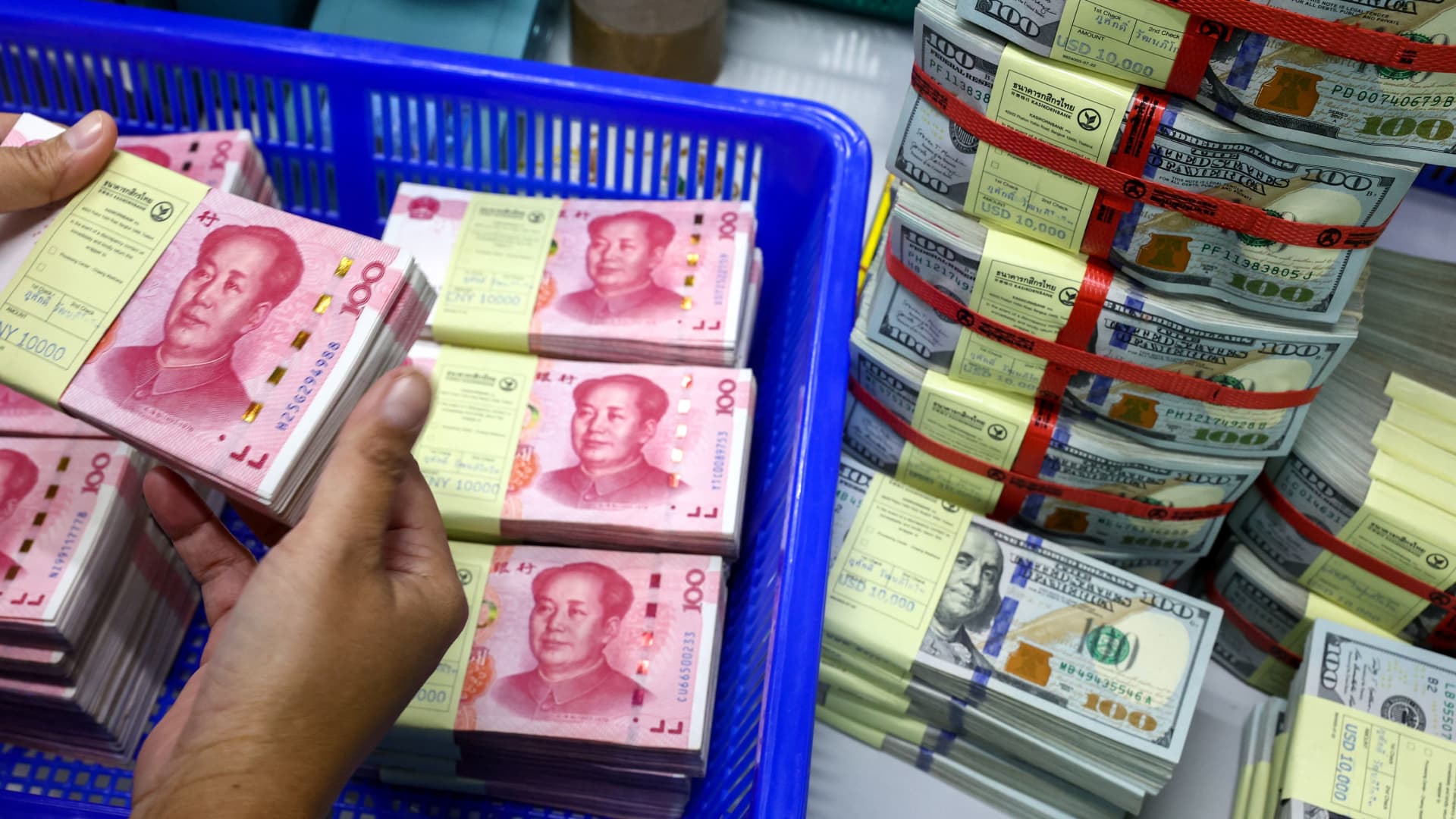
A bank employee count China’s renminbi (RMB) or yuan notes next to U.S. dollar notes at a Kasikornbank in Bangkok, Thailand, January 26, 2023.
Athit Perawongmetha | Reuters
BEIJING — Venture capitalists in China that once rose to fame with giant U.S. IPOs of consumer companies are under pressure to drastically change their strategy.
The urgency to adapt their playbook to a newer environment has increased in the last few years with stricter regulations in China as well as the U.S., tensions between the two countries and slowdown in the world’s second-largest economy.
Here are the three shifts that are underway:
1. From U.S. dollars to Chinese yuan
The business model for well-known venture capital funds in China such as Sequoia and Hillhouse typically involved raising dollars from university endowments, pension funds and other sources in the U.S. — known in the industry as limited partners.
That money then went into startups in China, which eventually sought initial public offerings in the U.S., generating returns for investors.
Now many of those limited partners have paused investing in China, as Washington increases its scrutiny of U.S. money backing advanced Chinese tech and it gets harder for Chinese companies to list in the U.S. A slowdown in the Asian country has further dampened investor sentiment.
That means venture capitalists in China need to look to alternative sources, such as the Middle East, or, increasingly, funds tied to local government coffers. The shift toward domestic channels also means a change in currency.

In 2023, the total venture capital funds raised in China dropped to their lowest since 2015, with the share of U.S. dollars falling to 5.3% from 8.4% in the prior year, according to Xiniu Data, an industry research firm.
That’s far less than in the previous years — the share of U.S. dollars in total VC funds raised was around 15% for the years 2018 to 2021, the data showed. The remaining share was in Chinese yuan.
Currently, many USD funds are shifting their focus to government-backed hard tech companies, which typically aim for A share exits rather than U.S. listings
For foreign investors, high U.S. interest rates and the relative attractiveness of markets such as India and Japan also factor into decisions around whether to invest in China.
“VCs have definitely changed their view on Greater China from a couple years ago,” Kyle Stanford, lead VC analyst at Pitchbook, said in an email.
“Greater China private markets still have a lot of capital available, whether it be from local funds, or from areas such as the Middle East, but in general the view on China growth and VC returns has changed,” he said.
2. China investments, China exits
Washington and Beijing in 2022 resolved a long-standing audit dispute that reduced the risk of Chinese companies having to delist from U.S. stock exchanges.
But following the fallout over Chinese ride-hailing giant Didi’s U.S. listing in the summer of 2021, the two countries have increased scrutiny of China-based companies wanting to go public in New York.
Beijing now requires companies with large amounts of user data — essentially any internet-based consumer-facing business in China — to receive approval from the cybersecurity regulator, among other measures, before they can list in Hong Kong or the U.S.
Washington has also tightened restrictions on American money going into high-tech Chinese companies. A few large VCs have separated their China operations from those in the U.S. under new names. Last year, Sequoia most famously rebranded in China as HongShan.
“USD funds in China can still invest in non-sensitive sectors for A share IPOs, but have the challenge of local enterprise preferring capital from RMB [Chinese yuan] funds,” said Liao Ming, founding partner of Beijing-based Prospect Avenue Capital, which has focused on U.S. dollar funds.
Stocks listed in the mainland Chinese market are known as A shares.
“The trend is shifting towards investing in parallel entity overseas assets, marking a strategic move ‘from long China to long Chinese,” he said.
“With U.S. IPOs no longer being a viable exit strategy for China assets, investors should target local exits in their respective capital markets—in other words, China exits for China assets, and U.S. exits for overseas assets,” Liao said.
Only a handful of China-based companies – and barely any large ones – have listed in the U.S. since Didi’s IPO. The company went public on the New York Stock Exchange in the summer of 2021, despite reported regulatory concerns.
Beijing promptly ordered an investigation that forced Didi to temporarily suspend new user registrations and app downloads. The company delisted later that year.
The probe, which has since ended, came alongside Beijing’s crackdown on alleged monopolistic practices by internet tech companies such as Alibaba. The clampdown also covered after-school tutoring, minors’ access to video games and real estate developers’ high reliance on debt for growth.
3. VC-government alignment, larger deals
Instead of consumer-facing sectors, Chinese authorities have emphasized support for industrial development, such as high-end manufacturing and renewable energy.
“Currently, many USD funds are shifting their focus to government-backed hard tech companies, which typically aim for A share exits rather than U.S. listings,” Liao said, noting that it aligns with Beijing’s preferences as well.
These companies include developers of new materials for renewable energy and factory automation components.
In 2023, the 20 largest VC deals for China-headquartered companies were mostly in manufacturing and included no e-commerce business, according to PitchBook data. In pre-pandemic 2019, the top deals included a few online shopping or internet-based consumer product companies, and some electric car start-ups.
The change is even more stark when compared with the boom around the time online shopping giant Alibaba went public in 2014. The 20 largest VC deals for China-headquartered companies in 2013 were predominantly in e-commerce and software services, according to PitchBook data.
… the venture capital scene has become even more state-concentrated and focused on government priorities.
Camille Boullenois
Rhodium Group
The shift away from internet apps towards hard tech requires more capital.
The median deal size in 2013 among those 20 largest China VC transactions was $80 million, according to CNBC calculations based off PitchBook data.
That’s far smaller than the median deal size of $280 million in 2019, and a fraction of the median of $804 million per transaction in 2023 for the same category of investments, the analysis showed.
Many of those deals were led by local government-backed funds or state-owned companies, in contrast to a decade earlier when VC names such as GGV Capital and internet tech companies were more prominent investors, according to the data.
“In the past 20 years, China and finance developed very quickly, and in the past ten years private [capital] funds grew very quickly, meaning just investing in any industry would [generate] returns,” Yang Luxia, partner and general manager at Heying Capital, said in Mandarin, translated by CNBC. She has been focused on yuan funds, while looking to raise capital from overseas.
Yang doesn’t expect the same pace of growth going forward, and said she is even taking a “conservative” approach to new energy. The technology changes quickly, making it hard to select winners, she said, while companies now need to consider buyouts and other alternatives to IPOs.
Then there’s the question of China’s growth itself, especially as state-linked funds and policies play a larger role in tech investment.
“In 2022, [private equity and venture capital] investment in China was cut in half, and it fell again in 2023. Private and foreign actors were the first to withdraw, so the venture capital scene has become even more state-concentrated and focused on government priorities,” said Camille Boullenois, associate director, Rhodium Group.
The risk is that science and technology becomes “more state-directed and aligned with government’s priorities,” she said. “That could be effective in the short term, but is unlikely to encourage a thriving innovation environment in the long term.”
Read the original article here