



An international team of researchers has shown that hybrid light-matter quasiparticles can enhance magneto-optical effects in layered crystals. This research has strong implications for the development of magneto-optic devices, such as sensors and imaging devices, which allow the direct determination and mapping of magnetic domains in materials. The research could also lead to the creation of high-speed switches and all-optically controlled magnetic memory devices.
The quasiparticles in this study were exciton–polaritons, which are hybrid light-matter states that can occur in an optical cavity where there is a sufficient interaction between the cavity photon mode and bound electron–hole pairs: excitons. Such as system is described as being “strongly coupled†and the polaritons possess characteristic properties of both light and matter. Due to their low effective mass and short lifetime (photonic properties) and their strong ability to interact (excitonic properties), polaritons are of great interest for an array of high-speed, low-loss technological applications, such as low-light sensors, logic devices, and quantum communications.
There has also been significant focus on the development of magneto-optical devices, which allow light to be manipulated using applied magnetic fields. A comprehensive understanding of the interaction between excitons and magnetic fields is needed for the creating such devices. To study these interactions, it is necessary to have a material with a strong magneto-optic response. Such a material had been difficult to find, but magnetic van der Waals (vdW) crystals have recently been shown to be very promising.
In this latest research, scientists at the City College of New York and the Advanced Science Research Centre of CUNY in the US in collaboration with an international team have shown that the presence of exciton–polaritons can further enhance the magneto-optical response in these materials. Their study is described in a paper in Nature.
Magnetically-controlled excitons
The vdW crystals used in this study were chromium sulphide bromide (CrSBr), which consists of quasi-2D layers of CrSBr held together by weak van der Waals forces. At low temperatures, the material is in an antiferromagnetic state in which the electron spins of adjacent layers are oppositely aligned. However, it is possible to switch the crystals into a ferromagnetic state (all spins are aligned) by applying a moderate magnetic field. While this transition often results in a magneto-optic effect that changes the polarization or intensity of the light (effects that most existing magneto-optic devices rely on), in CrSBr it is the exciton energy – and therefore the materials optical spectrum – that is altered.
In this study, Florian Dirnberger, Jiamin Quan and colleagues studied two types of CrSBr cavities. The first resembled a traditional optical cavity in which external, highly-reflective mirrors were deposited on either side of a CrSBr crystal. The second relied on the strong dielectric contrast between the crystal and its environment to confine the cavity photon mode within, forming a “mirrorless†cavity. Due to the extremely large exciton oscillator strength of CrSBr crystals, strong coupling between the photon mode and the magnetic excitons – and therefore the presence of exciton–polaritons – was observed.
Boosting bandwidth
By applying an external magnetic field to the crystals, the researchers were able to reduce the angle between the oppositely-aligned spins. This resulted in a decrease in exciton energy and switched the crystals from the antiferromagnetic to the ferromagnetic state. This energy change altered the relative exciton–photon fraction of the polaritons, shifting their energy levels and modifying the measured reflectivity spectrum.
In a weakly-coupled CrSBr crystal (without external mirrors), the magneto-optic response would only occur around the exciton energy. In this strongly-coupled system, however, polariton states exist far below the band gap, giving a significantly increased bandwidth of the magneto-optical response.
The researchers also investigated the effect of magnons on the system. These are quantized oscillations in the angle between the oppositely-aligned spins that also alter the exciton energy. Using ultrashort laser pulses to generate coherent magnons, they observed that the cavity reflectivity spectrum exhibited oscillations with a frequency matching that of coherent magnons in CrSBr. While this effect occurs in both cavities, it is greatly enhanced in the sample with external mirrors due to the reduced linewidth of the polaritons.
Coherence not always necessary
Surprisingly, the researchers also observed that incoherent magnons, which are generated thermally, can produce a pronounced magneto-optical response. Until this study, it was thought that coherence was necessary for such an effect. Using theoretical modelling, the researchers have now shown that, below a certain temperature, the temperature-dependence of the excitons in CrSBr is mainly affected by the population of incoherent magnons. This shows that optical spectroscopy of polaritons in such a system can be used as a new method for studying incoherent magnons in magnetic crystals.
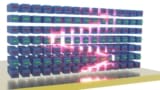
Exciton–polaritons enhance magneto-optical responses in van der Waals crystals
In its study, the team has shown that by utilizing the modification of energy levels in a system due to exciton-polaritons, it is possible to enhance the strength and spectral bandwidth of magneto-optic responses in a magnetic vdW crystal. This demonstrated tunability of such responses is highly promising for the development and study of novel magneto-optic switches, sensors and more.
“Given the strong interactions of magnetism and light observed in our study,†explains Dirnberger, who is first author of the Nature paper. “It is possible that one day magnetic lasers and all-optically controlled magnetic memory devices may revolutionize magneto-optic technology.â€