


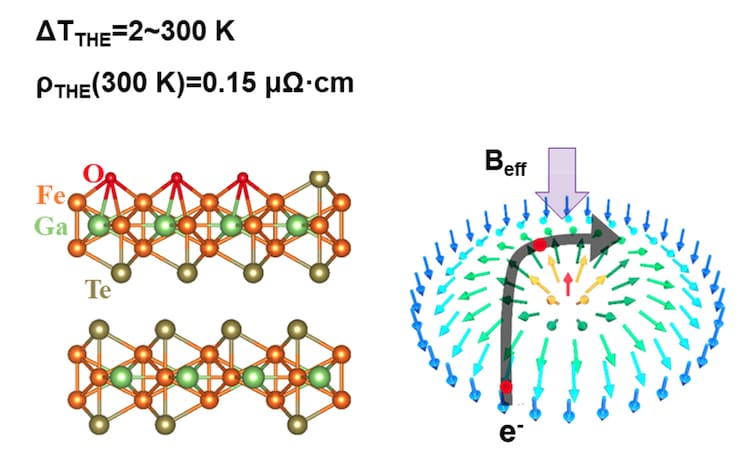
Researchers in China have produced a phenomenon known as the giant skyrmion topological Hall effect in a two-dimensional material using only a small amount of current to manipulate the skyrmions responsible for it. The finding, which a team at Huazhong University of Science and Technology in Hubei observed in a ferromagnetic crystal discovered in 2022, comes about thanks to an electronic spin interaction known to stabilize skyrmions. Since the effect was apparent at a wide range of temperatures, including room temperature, it could prove useful for developing two-dimensional topological and spintronic devices such as racetrack memory, logic gates and spin nano-oscillators.
Skyrmions are quasiparticles with a vortex-like structure, and they exist in many materials, notably magnetic thin films and multilayers. They are robust to external perturbations, and at just tens of nanometres across, they are much smaller than the magnetic domains used to encode data in today’s hard disks. That makes them ideal building blocks for future data storage technologies such as “racetrack†memories.
Skyrmions can generally be identified in a material by spotting unusual features (for example, abnormal resistivity) in the Hall effect, which occurs when electrons flow through a conductor in the presence of an applied magnetic field. The magnetic field exerts a sideways force on the electrons, leading to a voltage difference in the conductor that is proportional to the strength of the field. If the conductor has an internal magnetic field or magnetic spin texture, like a skyrmion does, this also affects the electrons. In these circumstances, the Hall effect is known as the skyrmion topological Hall effect (THE).
For quasiparticles to be useful as platforms for two-dimensional (2D) spintronic devices, a large THE is highly desirable, but the skyrmions also need to be stable over a wide temperature range and easy to manipulate using small electric currents. Until now, making skyrmions with all these properties has been difficult, says team leader Haixin Chang.
“Most known skyrmions and the THE are stabilized in only a narrow temperature window either below or above room temperature and require high critical current manipulation,†he tells Physics World. “It is still elusive and very challenging to achieve a large THE with both a wide temperature window up to room temperature and a low critical current for skyrmion manipulation, especially in 2D systems suitable for electronic and spintronic integrations.â€
Robust 2D skyrmion THE
Chang and colleagues are now reporting a 2D skyrmion that seems to fit the bill. Not only does the THE they observe remain robust over a temperature window spanning three orders of magnitude, it is also very large, measuring 5.4 µΩ·cm at 10 K and 0.15 µΩ·cm at 300 K. This is between one and three orders of magnitude bigger than previously reported room-temperature 2D skyrmion systems. And that is not all: the researchers found that their 2D skyrmion THE can be controlled with a low critical current density of around just 6.2×10⁵ A·cm-2. The researchers say this was possible due to the high-quality samples they fabricated (which have a finely-controllable 2D ferromagnetism), plus their precise quantitative analyses of the THE electrical measurements.
Chang thinks the team’s work paves the way for room-temperature electrically-controlled 2D THE and skyrmion-based practical spintronic and magnetoelectronic devices. “Room-temperature electrical detection and manipulation of skyrmions by the topological Hall effect are promising for next-generation low-power spintronic devices,†he says.
Where the effect comes from
The team also delved into possible reasons for the robust giant 2D skyrmion THE they observed. Based on their theoretical calculations, they found that the natural oxidation of the Fe3GaTe2-???? ferromagnetic crystal they studied enhanced a known skyrmion-stabilizing magnetic effect called the 2D interfacial Dzyaloshinskii–Moriya interaction (DMI). Hence, by carefully controlling the natural oxidation and thickness of the Fe3GaTe2-???? crystal, they formed a reliable oxidation interface with a sizeable interfacial DMI, and showed that they were able to produce a robust 2D skyrmion THE within a wide temperature window. This is no easy task because excessive oxidation can cause the structure of the crystal to degrade, while insufficient oxidation makes it hard to form a large interfacial DMI. Both extremes tend to hinder the formation of skyrmions and thus the THE.

Weak electric currents track tiny magnetic skyrmions
“Our group has been studying magnetism in 2D crystals since 2014 and we have developed many new magnetic crystals, including the one studied in this work,†says Chang. “Both skyrmions and the topological Hall effect are very interesting topological physical phenomena that are typically observed in some magnetic systems, but which have a lot of intrinsic limitations for practical applications.
“We conducted this study to try and overcome these limitations in traditional magnetic materials.â€
The researchers say their work, which is detailed in Chinese Physics Letters, could lead to a general methodology for tuning 2D DMI for spin transport control in 2D ferromagnetic crystals. “It also proves that oxidation can be used to induce a giant 2D THE much better than heavy metal and other so-called strong spin-orbit coupling compounds traditionally employed,†Chang says.
The Huazhong team is now looking into making racetrack memories and logic gate devices based on their 2D skyrmion systems for high-speed and high-density data storage, logic operation and what the researchers call “new-concept quantum computationâ€.