


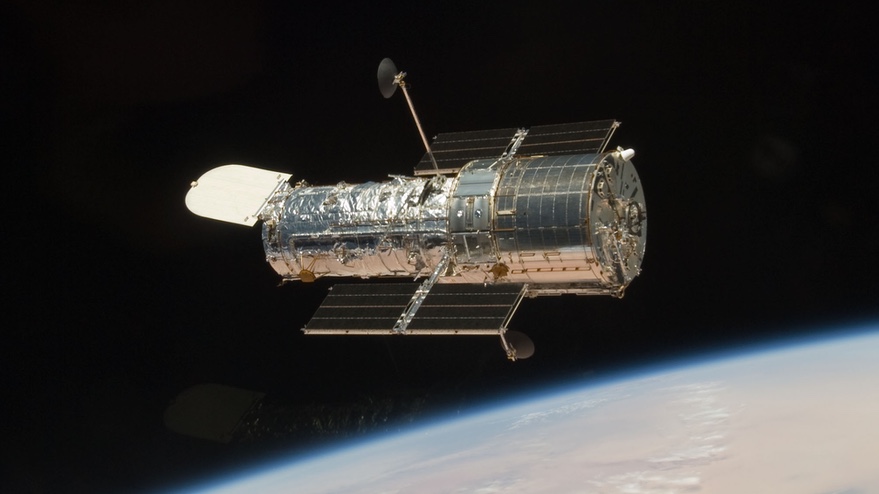
WASHINGTON — NASA will extend the life of the Hubble Space Telescope by switching to a mode where the spacecraft operates on a single gyroscope, having rejected for now commercial proposals to reboost or repair it.
The agency announced June 4 that one of three remaining gyros used to control pointing of the telescope had failed and could not be restored. The telescope had been out of service since that gyro failed May 24 after several previous cases where the gyro malfunctioned but was put back into service.
“After completing a series of tests and carefully considering our options, we have made the decision that we will transition Hubble to operate using only one of its three remaining gyros,” Mark Clampin, director of NASA’s astrophysics division, said in a call with reporters.
With two remaining working gyros, NASA is implementing a plan developed more than 20 years ago to move into an operational mode where it uses only a single gyro, turning the other off to serve as a backup. That will allow Hubble to continue operations into the 2030s, officials said.
Going into a single-gyro mode, which is expected to be in place by mid-June, does have drawbacks. Patrick Crouse, project manager for Hubble at the Goddard Space Flight Center, said that there will be a loss of efficiency in scheduling observations as it will take longer for Hubble to slew from one target to the next. He estimated a 12% reduction in observations from 85 orbits per week to 74.
There will also be decreased flexibility to schedule observations close to the sun because the single-gyro mode will have a larger exclusion zone. Hubble will be unable to observe moving objects closer than Mars, such as the moon or near Earth asteroids, although Crouse said those accounted for only about 1% of Hubble observations in recent years.
A 2016 study by the Space Telescope Science Institute, which handles Hubble science operations, estimated a 25% reduction in overall “scientific productivity” of the telescope when in single-gyro mode. Clampin said he was unfamiliar with the study but emphasized Hubble was still capable of a wide range of science. “I don’t personally see this as a major restriction on its ability to do important science.”
Officials were optimistic that going to a single-gyro mode will preserve Hubble to as late as the mid-2030s, when the spacecraft is currently predicted to reenter if no steps are taken to reboost its orbit or perform a controlled reentry.
The two remaining gyros are “enhanced” gyros installed on the final shuttle servicing mission to Hubble in 2009, designed to last up to five times the rated 50,000-hour rated lifetime of a standard gyro. One gyro has been operating for 142,000 hours and the other has nearly 90,000 hours. Neither has experienced any major problems, unlike the failed gyro that had long suffered issues.
Crouse said an engineering analysis concluded that there was at least a 70% chance Hubble will have at least one working gyro through the mid-2030s. Other spacecraft systems as well as its instruments are also working well. “We do not see Hubble as being on its last legs,” he concluded.
Clampin said that the change to single-gyro operations won’t affect ongoing efforts by NASA to seek cost savings from both Hubble and the Chandra X-ray Observatory. NASA announced in March it would conduct what it called an Operations Paradigm Change Review to see how to cut aspects of operations of both telescopes to reduce their annual costs, which for Hubble is about $95 million.
“I don’t think it changes the outcome of that review,” he said. That review has been completed and is currently being analyzed by NASA. He expected to provide an update on the review and its implications for Hubble and Chandra later this summer.
No private servicing mission — for now
Past problems with the faulty gyro on Hubble had renewed talk of sending a private mission to the space telescope to raise its orbit and possible repair it. In September 2022, NASA announced it signed a Space Act Agreement with SpaceX to study a Hubble reboost mission using a Crew Dragon spacecraft, with the option of performing repairs like installing new gyros. That review was completed more than a year ago but neither NASA nor SpaceX provided details about the results or next steps.
Clampin said NASA, after assessing that study and other concepts, would not pursue a commercial servicing mission. “Our position right now is that, after exploring the current commercial capabilities, we are not going to pursue a reboost right now,” he said.
He said his concern was the risk that a private mission might damage the telescope. “Our assessment also raised a number of considerations, including potential risks such as premature loss of science and some technology challenges,” he said. An example of those risks he offered was contamination of Hubble’s mirror from volatiles like thruster plumes.
The NASA/SpaceX study did not offer a recommendation for or against carrying out the mission, Clampin said, and the study only looked at “notional concepts” for upgrades such as installing new gyroscopes that did not go into technical detail. “For the time being, we are stepping back.”
However, he did not rule out reconsidering a private reboost or servicing mission at some later point. “While the reboost is an option for the future, we think we need to do some additional work to determine whether the long-term science return will outweigh the short-term science risk.”
Related
Read the original article here