
Close Menu
Chicago News Journal
    Facebook X (Twitter) Instagram
    • Contact us
    • About us
    • Amazon Disclaimer
    • DMCA / Copyrights Disclaimer
    • Privacy Policy
    • Terms and Conditions
    Facebook X (Twitter) Instagram YouTube TikTok
    Chicago News JournalChicago News Journal
    • Home
    • US News
    • Politics
    • Business
    • Science
    • Technology
    • LifeStyle
    • Music
    • Television
    • Film
    • Books
    • Contact
      • About us
      • Amazon Disclaimer
      • DMCA / Copyrights Disclaimer
      • Privacy Policy
      • Terms and Conditions
    Chicago News Journal
    Home»Science

    Lots of oxygen existed in the early universe, JWST reveals

    AdminBy AdminDecember 6, 2023 Science
    Facebook Twitter Pinterest LinkedIn Tumblr Email Reddit Telegram


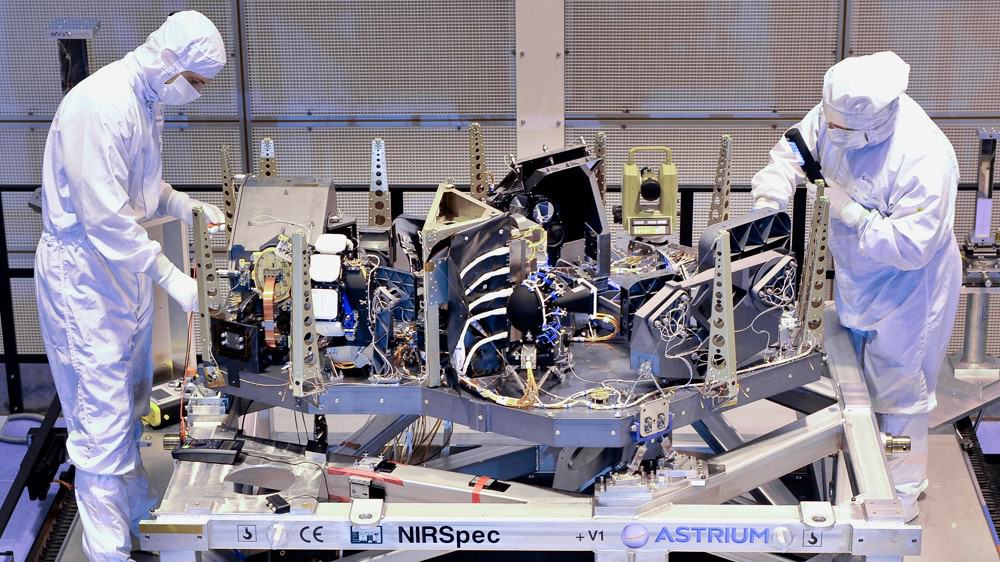
    NIRSpec
    Cutting edge: NIRSpec being readied for the launch of the JWST. (Courtesy: Astrium/NIRSpec)

    Using a cutting-edge spectrograph on the James Webb Space Telescope (JWST), astronomers have found evidence that interstellar oxygen was far more abundant in many ancient galaxies than previously thought. Led by Kimihiko Nakajima at the National Astronomical Observatory of Japan, the team hopes that their observations could improve our understanding of the early universe.

    The Big Bang created an early universe that was made of hydrogen and helium, with a tiny bit of lithium – and this matter coalesced to form the first stars and galaxies. Heavier elements such as oxygen were then created by nuclear fusion in the cores of these stars. As the stars exploded as supernovae, heavy elements were dispersed across entire galaxies, forever transforming the chemical composition of the cosmos.

    “Gas-phase metallicity” is an observational parameter that describes the abundance of these heavier elements in galaxies (astronomers use the term metal for all elements heavier than helium). Its value is crucial for understanding a galaxy’s evolutionary history, as well as predicting when complex molecules – the possible building blocks of life – may begin to emerge.

    Reliable gauge

    A reliable gauge of a galaxy’s gas-phase metallicity is the abundance of ionized oxygen in its interstellar medium. This abundance can be determined by observing the characteristic light emitted by oxygen. However, this approach has its limits when observing the very early universe.

    “Previous observations had already revealed the presence of abundant oxygen in galaxies approximately two billion years after the Big Bang,” Nakajima explains. “However, the light from galaxies that existed even further back in time is significantly affected by the universe’s expansion, causing it to shift into the near-infrared range.”

    Now, Nakajima and colleagues have observed this red-shifted light using the JWST’s Near Infrared Spectrograph (NIRSpec) – and this has allowed them to make a breakthrough in measuring the gas-phase metallicity of ancient galaxies.

    Breakthrough observations

    “We identified 138 ancient galaxies that existed over 12 billion years ago and determined their oxygen abundances, a level of analysis nearly impossible prior to the launch of JWST,” Nakajima enthuses. “We developed and rigorously applied advanced analysis techniques to the NIRSpec data, conducting analyses on a scale several times larger than earlier studies.”

    NIRSpec

    JWST spectrometer refines redshifts of distant galaxies


    Their results reveal that in all but a few of the oldest galaxies observed by NIRSpec, the composition of the interstellar medium was remarkably familiar. “Most of the galaxies had oxygen abundances similar to modern galaxies,” Nakajima says. However, six of the most ancient galaxies that existed when the universe was only 500–700 million years old had much less oxygen than modern galaxies.

    With this discovery, the team could more closely pinpoint when the universe’s elemental composition began to change. “The results demonstrate a rapid and dramatic increase in the abundance of oxygen in galaxies during the first 500-700 million years after the birth of the universe,” Nakajima says. “This finding may suggest that, with necessary ingredients like oxygen already readily available in the early universe, life may have appeared sooner than previously thought.”

    The team speculates that this sudden change could have been caused by differences in the nature of star formation in the early universe, as well as material flowing in and out of its galaxies. Through further observations with NIRSpec, combined with more in-depth statistical calculations, they will now aim to build a more robust theory in their future work.

    The observations are described in The Astrophysical Journal Supplement Series.

    Share. Facebook Twitter Pinterest LinkedIn Tumblr Email Reddit Telegram

    You might also be interested in...

    Deposition Sciences, Inc. Expands Sunshade® Tape Offering with New 12″ × 30″ Format

    October 7, 2026

    Inventors of optogenetics win Nobel Prize in Physiology or Medicine – Physics World

    October 6, 2026

    Rethinking risk with electronics for space

    October 5, 2026

    how are researchers making weather predictions more accurate? – Physics World

    October 4, 2026

    World Space Week 2026 Celebrates the “Rocket Revolution” 

    October 3, 2026

    Festival season finds Quantum Software Lab in high spirits – Physics World

    October 2, 2026
    Popular Posts

    Meta Muse popularity lifts AMD stock as AI agents juice CPU sales

    FKA twigs Files New Lawsuit Against Shia LaBeouf Over “Illegal” NDA

    Trump says MAGA Inc. PAC to pay for TV ads that praised him

    Writers, Ink Podcast: Why Strange Might Be the New Normal With Debut Author, Gillian Daniels

    High-End Colognes Are Surprisingly Cheap Right Now

    ‘The Price Is Right’ Fans Complain About This Big Season 55 Change

    Categories
    • Books (2,376)
    • Business (3,355)
    • Events (32)
    • Film (258)
    • LifeStyle (2,843)
    • Music (2,711)
    • Politics (2,276)
    • Science (1,894)
    • Technology (1,788)
    • Television (4,291)
    • Uncategorized (3)
    • US News (3,206)
    Archives
    Useful Links
    • Contact us
    • About us
    • Amazon Disclaimer
    • DMCA / Copyrights Disclaimer
    • Privacy Policy
    • Terms and Conditions
    Popular Posts
    • Moonquakes and landslides make the lunar south pole unstable – Physics WorldMoonquakes and landslides make the lunar south pole unstable – Physics World
    • ‘Dirty Dancing’ Set For Stage Musical Adaptation‘Dirty Dancing’ Set For Stage Musical Adaptation
    • Priyanka Chopra Wore  Sneakers and a Birkin to the AirportPriyanka Chopra Wore $60 Sneakers and a Birkin to the Airport
    • Hayley Williams, Mitski, Ethel Cain Set for All Things Go Festival 2026Hayley Williams, Mitski, Ethel Cain Set for All Things Go Festival 2026
    • Investor Bill Ackman, David Sacks’ PAC donated to RFK Jr.’s presidential campaign
    Archives
    Categories
    • Books
    • Business
    • Events
    • Film
    • LifeStyle
    • Music
    • Politics
    • Science
    • Technology
    • Television
    • Uncategorized
    • US News
    Facebook X (Twitter) Instagram YouTube TikTok
    © 2026 Chicago News Journal. All rights reserved. All articles, images, product names, logos, and brands are property of their respective owners. All company, product and service names used in this website are for identification purposes only. Use of these names, logos, and brands does not imply endorsement unless specified. By using this site, you agree to the Terms of Use and Privacy Policy.

    Type above and press Enter to search. Press Esc to cancel.