


Nina Heinig is a materials researcher who manages the Waterloo Advanced Technology Laboratory (WATLab), which is a multidisciplinary materials characterization and fabrication research centre in Waterloo, Canada. She tells Hamish Johnston about WATLab’s instruments and services and how they are used by researchers in a wide range of fields

Can you give a brief description of WATLab, its main instruments and what your provide to users main instruments and what you provide to users
WATLab is a multiuser metrology facility in the Department of Chemistry of the University of Waterloo. It was established in 2000 by professor Kam Tong Leung and its first two instruments were a Leo 1530 field emission microscope and a VG EscaLab X-ray photoelectron spectroscopy (XPS) tool. Today, the most commonly accessed instruments include scanning electron microscopes (SEMs), XPS, a high resolution transmission electron microscope (HRTEM), electron and ion beam lithography systems (supplied by Raith), secondary ion mass spectrometry (SIMS), as well as atom force microscopy, X-ray diffraction and Raman and imaging spectroscopy. We also have more specialized tools, such as a Zeiss helium ion microscope and a Thermo VG Auger imaging microscope, with the complete list available on our website, watlabs.com.
How do users interact with WATLab? Do they come in to use the equipment, or do they send their samples to you?
During the COVID-19 pandemic, we pivoted to remote service. However, we have now gone back to our usual mix of user operated (mainly SEM) and operator service metrology. Education was a big part of the original mandate from our funding agencies, and we offer short training classes on using some of the tools safely and effectively. Most projects also involve discussions with the users on how to interpret their results and understand the limitations of the data. However, much of our funding is on a fee-for-service model, so extensive discussions and user operation of our more complex and expensive tools is simply not cost effective.
Can you give us an idea of your user base at the university – what departments do users come from?
Most of our users are students and faculty at the University of Waterloo, and local technology companies. We also assist researchers from universities and early-stage companies from across Canada and in the US. Most of our tools and expertise is related to inorganic materials such as metals, ceramics, semiconductors, although we have done several polymer and life sciences projects. Our user base at Waterloo spans chemistry, physics, earth and environmental sciences. We also work with people in engineering departments including mechanical, chemical, civil and systems design engineering – and we do occasional projects with people from other university departments.
What are some of the most popular services that you offer?
Our most popular tools are the field-emission scanning electron microscopes with energy dispersive X-ray spectroscopy (SEM/EDS). In nanoscience, the ability to easily observe and analyse materials on the tens-of-nanometre length scale is one of reasons that the field has expanded so much in recent years.
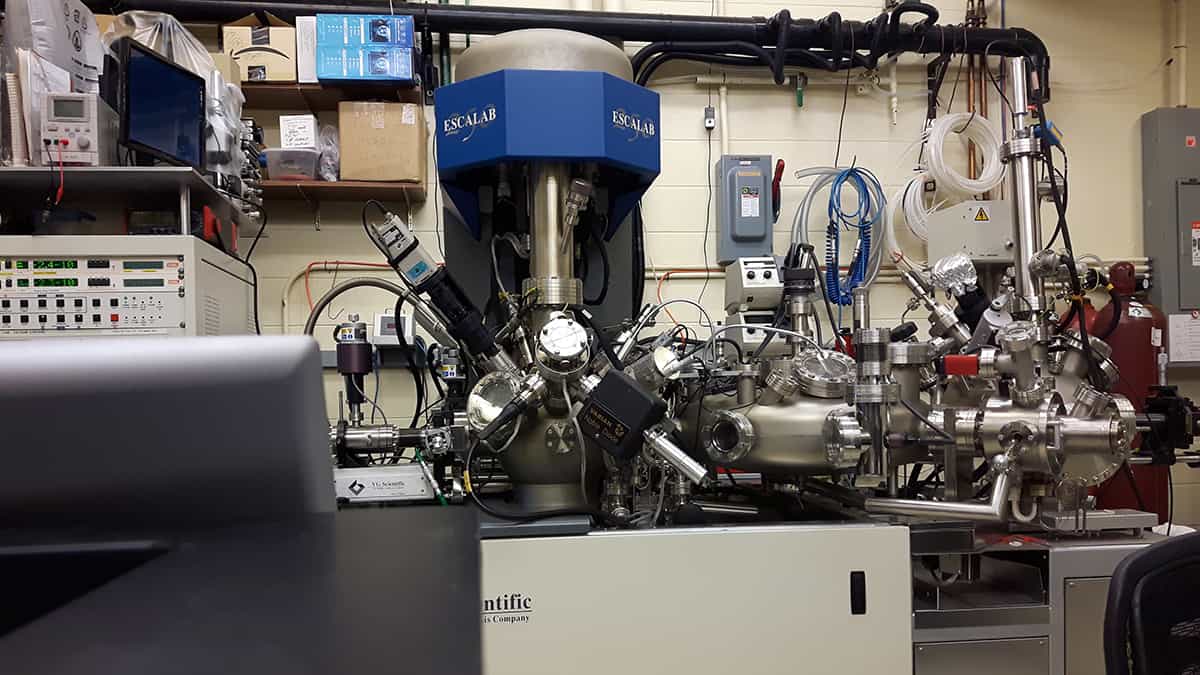
After that, the VG-ESCALab XPS tool is the piece of equipment most reserved by our users. XPS is a powerful tool for analysing the valence state of various compounds. For example, graphite has carbon bonds with sp2 hybridization and diamond sp3 hybridization. These different bonding structures can be observed in the XPS as a shift in the carbon kinetic energy peak. Another advantage of XPS is its extreme surface sensitivity. XPS normally probes only the one or two nanometres of the sample surface, without any noise from the underlying substrate. This allows one to accurately analyse thin film materials.
Can you give a few examples of some notable scientific research and industrial work that has been done at WATLab?
Locally, we have assisted with fabrication trouble-shooting and environmental remediation. One Earth sciences faculty member had a project looking for the presence and form of arsenic in the soil near a mining site. We went through a large number of thin section samples with the SEM to find the heavy precipitated arsenic minerals, and evaluated these with EDS and XPS to determine if the arsenic compounds were inert or environmentally active.
An older project for Waterloo-based BlackBerry was to evaluate materials in their supply chain for the presence of hexavalent chromium, which is carcinogenic and banned in the European Union. Since various valences of chromium are commonly used in pigments, and only hexavalent chromium is dangerous, the ESCALab was used to determine the chromium bonding state in materials.
More recently, a local start-up company developed a new process for fabricating melt-blown polymer fibres with longer and finer fibres for various applications including diapers, wipes, and filters. Then COVID-19 appeared, so the company focussed on the filter application. Thinner fibres allow smaller particles to be removed with a smaller pressure drop across the filter, which improves efficiency. We used the SEM to image their fibre materials made under different conditions, to determine which factors were optimal.
What career path did you follow to work at WATLab?

How Treesearch is studying the secrets of forest materials with synchrotron science
I did a physics undergraduate degree at McGill University in Montreal, and a PhD in materials science and engineering at the University of Wisconsin-Madison in the US. My PhD project was fabricating, analysing and measuring the superconducting properties of yttrium barium copper oxide grain boundaries. After that, I worked as a post-doc and research scientist in California, before returning to Canada. This gave me experience with a variety of tools and measurement techniques, as well as experience trouble-shooting equipment.
What do you enjoy the most about your job?
The most interesting thing about working at WATLab is the variety of different projects that our users are working on. Studying artefacts (or not!) in a new dataset is always challenging. I have learned a lot about our tools, and about how to apply these tools in a number of academic areas. Teaching and communicating with users are other important skills that I have developed while at WATLab.