



The most distant galactic magnetic field ever observed has been reported by an international team of astronomers. The field belonged to a galaxy called 9io9, which we see as it was about 11 billion years ago – about 2.5 billion years after the universe was created in the Big Bang. The discovery was made by studying radiation emitted by dust grains that were aligned by the galaxy’s magnetic field.
Magnetic fields have long been known to play a key role in the formation of stars and galaxies. However, large-scale ordered magnetic fields have only been observed in the Milky Way and nearby galaxies.
While there has been some theoretical work on the subject, it had not been known how rapidly magnetic fields could form around young galaxies and hence play a role in their future evolution.
Poorly understood
“Magnetic fields are one of those things that are key components in galaxies but that are relatively poorly understood, compared to other processes involved,†explains James Geach, from the University of Hertfordshire, who is the lead author of a paper in Nature that describes the discovery.
One reason for this poor understanding is that detecting distant magnetic fields in young galaxies is a technical challenge. As a result, magnetic fields have often being absent in many models and simulations of galaxy formation and evolution. “There was a chance that the field may be very faint, and we may not be able to detect it,†Geach explains.
The scientists chose to study 9io9 because it is a particularly luminous galaxy that is gravitationally lensed. This lensing occurs when a massive object, like a black hole or a galaxy cluster, bends light from the galaxy that passes nearby. This can have the effect of magnifying the galaxy as it is seen on Earth.
Compass needles
Using the Atacama Large Millimeter/Submillimeter Array (ALMA) in Chile, the team detected thermal emissions from dust grains around 9io9. Dust grains are not perfectly spherical, so they can align to a magnetic field like compass needles. These grains can absorb electromagnetic radiation and re-emit it at longer wavelengths
If the dust grains are magnetically aligned, they will emit polarized light. By analysing the degree and orientation of this polarization, the team could infer the direction and strength of the magnetic field in the region where the dust grains were located. They found that 9io9’s field strength is about 20 times that of the Milky Way and extends about 16,000 light–years across . The team used these data to create a magnetic field map of the distant galaxy.
“This is showing that even within a relatively limited time span from the Big Bang, magnetic fields like the ones we see in more local galaxies can be established,†explains Geach.
Rainer Beck is an expert on galactic magnetic fields, who retired from the Max-Planck Institute for Radioastronomy in 2018. He told Physics World that he was surprised by 9io9’s field strength: “It is really amazing, and it’s something that says that magnetic forces are already very, very important in the very early universeâ€.
Peering back in time
Beck adds that that 9io9 represents an “enormous jump†in our understanding of the magnetic fields of older galaxies. “Until now, we’ve only had some indication of ordered fields up to a redshift of 0.4, but this is a redshift of 2.6.â€
Redshift refers to the degree to which the wavelength of light from the galaxy has been stretched by the ongoing expansion of the universe – with higher redshifts corresponding to older and more distant objects.
As observed, galaxy 9io9 is a still in its infancy and is located in the early universe. As a result, it is still rich in turbulent ionized gases that have not collapsed to form stars, and the researchers have developed a theory about how this turbulence is related the magnetic field.
Turbulent motion
The galaxy is shaped like a disc that rotates rapidly. It also contains turbulent motion from stellar feedback, which refers to the physical processes of stars that can shape their environment. This includes stellar winds, which are jets of charged particles that shoot out of stars.
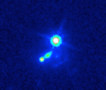
Distant galaxy sheds light on the magnetic universe
“We think that it’s that intense star formation that’s churning up the gas that has initially amplified the magnetic field,†said Geach, “You have the rotation of the galaxy happening at the same time, which is sort of winding up the field into a more coherent structure.â€
The team suggests that this “dual dynamo†may be how galactic-scale ordered magnetic fields can form early in young galaxies.
Geach says that future studies can aim to map the magnetic field in higher resolution to resolve the different components of the field and reveal its fine structure.