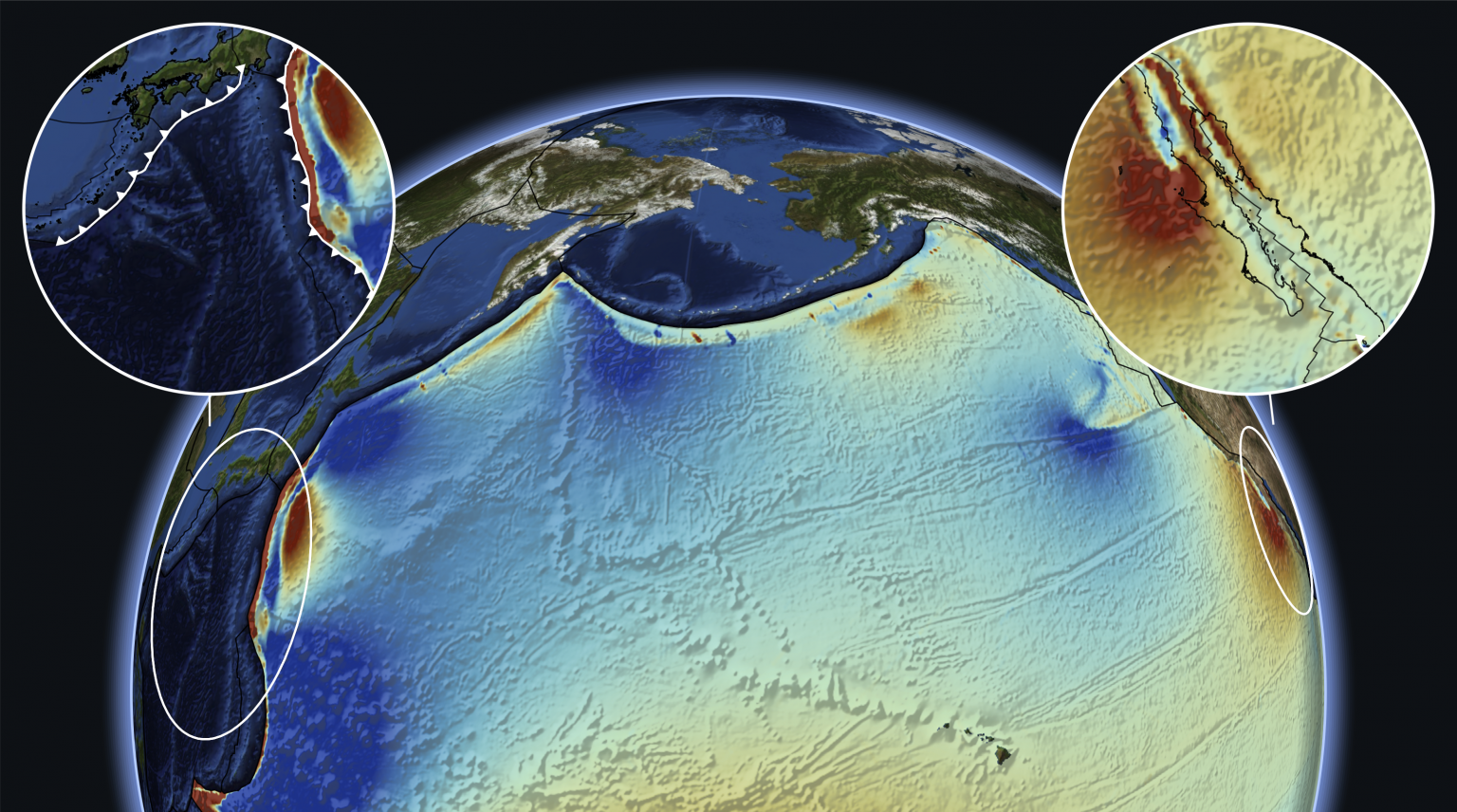
A geological reorganization near Japan may have led to the formation of one of North America’s most recognizable features.
The birth of the Gulf of California, which rifted from Mexico and created the Baja Peninsula 6 million to 8 million years ago, was accelerated by the formation of a double subduction zone more than 6,000 miles (9,600 kilometers) away, near Japan. This reorganization led to a transfer of tectonic force across the Pacific tectonic plate, which, in turn, opened the Gulf of California and ultimately led to the Grand Canyon’s formation, according to new research published Oct. 29 in the journal Science.
The findings will help researchers understand more about plate boundaries, which is where most of the strongest earthquakes on the planet originate.
Latest Videos FromLive Science
“It’s more than a regional curiosity,” study co-author Thorsten Becker, a geophysicist at the University of Texas at Austin (UT Austin), told Live Science. “It’s a reminder of the global connectedness of mantle convection and plate tectonics.”
The Gulf of California is an example of a rift zone, a place where continental crust pulls apart and creates a spot so low that it can be filled by ocean water. There are many rift zones around the world; a currently active one is the Red Sea. But rifting can slow down, speed up or peter out entirely. In the Gulf of California, rifting not only persisted, but sped up. Rifting took about 6 million to 13 million years — much quicker than the typical speed of 30 million to 80 million years.
Study co-author Guido Gianni, a geophysicist at the Czech Academy of Sciences, wondered why that was. No previous research fully explained the rapid rifting, which changed the face of North America in many ways. Not only did the rifting transfer Baja California to the Pacific Plate, but it provided an outlet for the developing Colorado River, which subsequently carved the Grand Canyon on its way to sea level.
Gianni and Becker’s doctoral student at UT Austin, Xiang He, used a global model of plate tectonics, run on supercomputers at the Texas Advanced Computing Center on campus, to find out if far-flung forces might provide an explanation. Around the same time the Gulf of California was pulling apart, Japan was undergoing its own geological changes. Off the coast of Japan, the Pacific Plate subducts, or pushes under, the Eurasian Plate. About 10 million to 12 million years ago, a single subduction zone near Japan transitioned into two separate subduction zones.
Get the world’s most fascinating discoveries delivered straight to your inbox.
A double subduction zone off Japan (left inset) accelerated the growth of the Gulf of California (right inset).
(Image credit: He et al.)
This transition at the western end of the Pacific Plate influenced the tectonic forces on the other side of the plate, He, Gianni, Becker and their colleagues found.
“It turned out — ta-da! — [with] the change in this pulling stress, Baja California was one of the few places outside the Japan region that were affected,” Becker said. It was “unexpected and sort of a little bit too good to be true.”
The researchers tweaked their model to see if the result held with different assumptions about stresses and mantle properties, and it did.
The Gulf of California was already rifting regardless of the situation across the Pacific. The initial rift was caused by the subduction of a tectonic plate called the Farallon Plate, located under the West Coast of North America. The Farallon slab stretched and thinned the continental crust of the North American plate as it moved. But such rifting might have ended with nothing more than the formation of a little valley or low spot if Japan’s influence had not kicked in to give the rifting some extra oomph.
The findings have a direct effect on scientists’ understanding of how plate boundaries form, Becker said. And this isn’t just academic. The findings could have implications for understanding earthquake-generating faults such as the San Andreas in California and the Cascadia subduction zone in the Pacific Northwest, Becker said. Cascadia is what’s known as a “megathrust” boundary, capable of triggering quakes of more than magnitude 9.
“If I’m asking what is the mantle doing underneath Cascadia so I get our megathrust correct,” Becker said, “I need to include these effects.”
Gianni, G. M., He, X., Becker, T. W., & Faccenna, C. (2026). Western Pacific double subduction drives Gulf of California rifting. Science, 394(6823), 515–519. https://doi.org/10.1126/science.aef5187