


Dinosaurs are more than extraordinary specimens with massive price tags. They are irreplaceable snapshots of our planet’s history and our own human journey. When scientifically important fossils are reduced to luxury commodities, we are robbed of the evidence that makes them valuable in the first place.
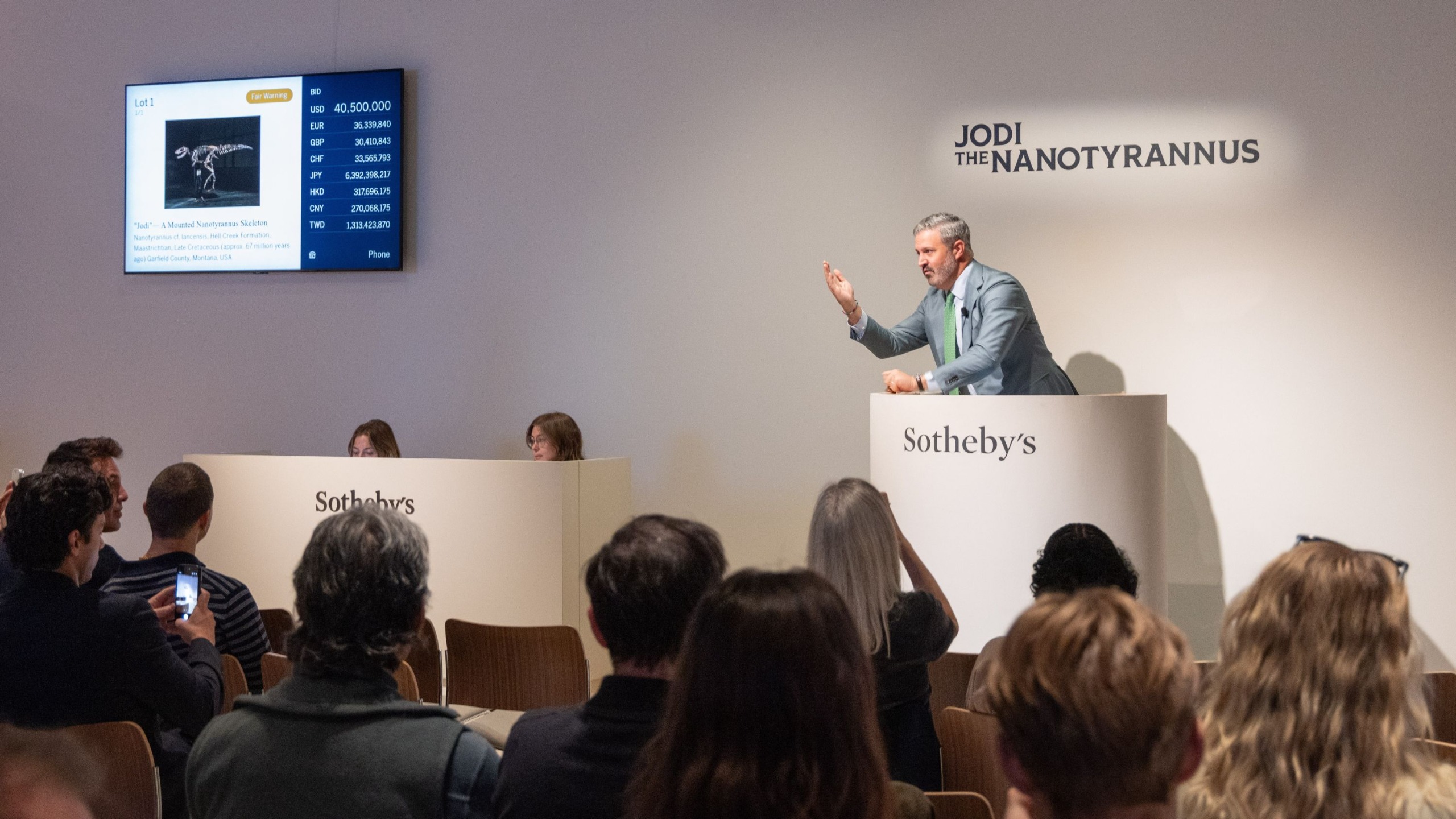
On Oct. 27, a 19.6-foot-long (6 meters) skeleton of Nanotyrannus lancensis known as “Jodi” was sold at Sotheby’s in New York for $47,255,000, far exceeding its $6 million to $9 million estimate. The buyer and seller were not identified. It was the latest in a string of multimillion-dollar dinosaur auctions, following the $50.1 million sale of a T. rex (Gus) in July and the $44.6 million sale of a Stegosaurus (Apex) in 2024.
Fossils like Jodi, Apex, and Gus belong in public collections, where they can contribute to science and remain accessible for future generations. Not in the hands of private collectors.
There are three main reasons why. First: Fossils are evidence, not objects. A dinosaur’s bones can reveal how it grew, moved, fed, and lived. They preserve traces of injury and disease, help reconstruct ancient ecosystems, and offer clues about the “rules of life” governing our world that scientists are still learning to interpret.
Jodi illustrates exactly why access to physical evidence matters. For nearly half a century, paleontologists debated whether Nanotyrannus was a distinct dinosaur or simply a juvenile T. rex. A lack of well-preserved fossils available for study only fueled the uncertainty. And then a remarkable specimen, once in private hands, moved into the public trust.
The fossil was uncovered in Montana in 2006 alongside a Triceratops. Dubbed the “Dueling Dinosaurs,” it took until 2020, and an appeal in the state’s Supreme Court, for the remains to be acquired by the Museum of Natural Sciences so they could be fully studied. This research provided a powerful new perspective, arguing that Nanotyrannus lancensis was a distinct dinosaur and, moreover, that a second species of Nanotyrannus once roamed the American West.
When access relies on a private owner’s permission, repeatability is not assured, and science cannot proceed. A specimen might be available today but inaccessible tomorrow.
This hypothesis has big implications for the health of ecosystems before one of Earth’s most severe extinction events — but it currently rests on the scant few Nanotyrannus specimens housed in public collections. Specimens like Jodi could uphold or dethrone it. Without access, we, and Jodi’s true identity, will remain in the dark.
It is hard to overstate the irony of Jodi’s sale: a specimen recently listed for sale as a juvenile T. rex now captures the world’s imagination, and commands double the price tag, as a “Nanotyrannus.” Yet if a similar fate had befallen the Dueling Dinosaurs and they had remained in private hands, we would never have known for certain that Nanotyrannus existed.
Scientific progress depends on researchers being able to compare specimens, test hypotheses, and revisit earlier conclusions. When access relies on a private owner’s permission, repeatability is not assured, and science cannot proceed. A specimen might be available today but inaccessible tomorrow. This is why access to the evidence must endure.
This brings us to the second problem with privately owned dinosaurs. Digital scans cannot replace the original fossil.
Three-dimensional scans and digital models are powerful tools. We use them to measure bones, compare anatomy, share information, and educate the public. But digital models capture only the most superficial aspects of a fossil’s story.

The auction took place on Oct. 27, with Jodi eventually selling for around five times the top estimate.
(Image credit: Ben Levine, Courtesy of Sotheby’s)
To understand dinosaur growth, we examine microscopic structures inside fossilized bone through a technique called bone histology. Other scientists analyze the chemistry of fossils to investigate diet, migration patterns, and metabolism. Such work requires physical samples, not just images of a bone’s surface. We also need contextual data about the surrounding sediments, preservation mode, and ancient environment in order to explore questions about the ecosystems in which the animals once lived. Much of this information is lost in the rush to excavate and prepare fossils as quickly as possible for the auction block.
We cannot predict what new technologies future researchers will employ to make new discoveries from old bones, or even which questions they will ask. Technology will continue to advance, bringing analytical methods we cannot yet anticipate. A scan made today cannot guarantee that researchers will have the physical evidence needed for tomorrow’s discoveries. Digital access should complement preservation of original specimens, not justify losing it.
Finally, private ownership cannot guarantee lasting public access. Yes, some private collectors financially support research and education and donate specimens they purchase. Those contributions are valuable. But the issue is not whether an individual owner is generous; it is whether access is guaranteed over time.
A temporary loan is insufficient. A loaned specimen can be withdrawn, sold, or inherited by someone with different priorities, situations that are becoming increasingly common in the U.S. and abroad. By contrast, a fossil deposited in a responsible public research institution is documented, cared for, studied, and made available to future researchers and educators in perpetuity. The question is not whether people should be able to admire dinosaurs; it is whether the evidence that helps us understand them will remain available to everyone.
Exclusive to Live Science Pro
Nor should museums consider selling scientifically important fossils to cover operating shortfalls. Collections are not ordinary financial assets to liquidate when budgets tighten. Selling an irreplaceable specimen provides a one-time payment while sacrificing future scientific potential. Museums need sustainable funding for collections care, research, and education, not pressure to trade away the very resources they exist to preserve.
Jodi’s sale is complete, but the fossil’s long-term future remains uncertain. With the buyer’s identity undisclosed, the public cannot know what arrangements, if any, will ensure continued access for researchers and educators. We hope the new owner will make Jodi available for scientific study and public education, ideally through permanent placement in a public research institution. But hope is not a substitute for a guarantee.
There is a better way to support paleontology. Enthusiasts who want to share in the excitement of discovery can fund fieldwork and research, endow curatorial positions, strengthen museum collections, or donate important fossils to public institutions where we can all learn from them.
Dinosaurs inspire wonder because they connect us to a world vastly different from our own. But their importance extends far beyond their power to captivate us. They are part of our shared natural heritage and an irreplaceable record of Earth’s history.
We should measure a dinosaur’s worth not by the price it commands at auction, but by the knowledge it can help us build, and by whether we preserve that opportunity for generations to come. Earth’s history belongs to all of us, not to the highest bidder.
Opinion on Live Science gives you insight on the most important issues in science that affect you and the world around you today, written by experts and leading scientists in their field.
Help us improve Live Science Pro: We’re always trying to make our content better. Leave us feedback about Pro here.

Lindsay Zanno is a vertebrate paleontologist, National Geographic Explorer, and Head of Paleontology at the North Carolina Museum of Natural Sciences, where she leads research and public engagement initiatives, including the award-winning Dueling Dinosaurs experience. She is also an Associate Research Professor at NC State University, President of the Jurassic Foundation, and Chair of the Ethics Committee for the Society of Vertebrate Paleontology. Her work champions transparency, inclusivity, and public access to science.
Read the original article here